Do you feel as if you know your genre? Do you feel as if you're grasping at straws when you write, hoping that what you put out in the fantasy, Christian fiction, or YA genre is correct? Do you hope you are doing it right?
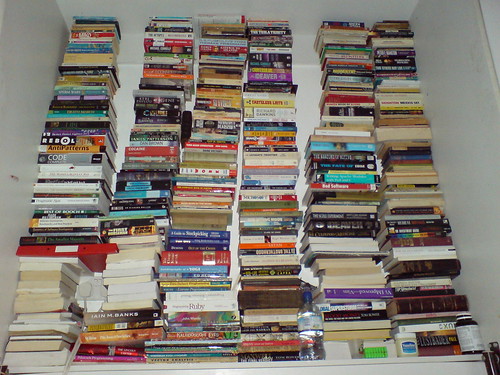
Photo by: Ben Oh, courtesy of Flickr
Straw grasping may work for getting a soda at the local McDonald's, but it doesn't work when you're trying to create a real world on another planet without having read any other fantasy authors who have dealt with the subject.
What about writing YA, when you have a difficult time relating to teenagers? What if you're unaware of the current lingo or concerns today's teenagers are facing?
What if you're writing a historical fiction book without doing any research?
Writing a mystery novel is different from writing even a fantasy novel.
And writing for children is different from writing for adults.
If you're feeling a little shaky....
1. Learn from novelists that write in your genre. That means reading their books and taking their classes.
2. Take time out to smell the roses. If you don't have children of your own and want to write for this age group, for example, offer to do some babysitting, make some time to go to a park and observe, take a visit to the zoo. Ask questions of your nieces of nephews. Take them overnight.
3. Study. Study the craft of writing as well as the genre in which you want to write.
4. Practice. You may find through your writing that what you thought was your strong point (general fiction) is in fact (fantasy). You learn what you're good at by writing and that includes writing exercises and writing prompts.
5. Don't guess. If you're not sure what the capitol of Oregon is, don't guess. Look it up.
6. Have readers who read your genre on a regular basis read your book before it goes to print. Listen to their concerns. Makes some editing decisions to improve your work.
Photo by: panduh, courtesy of Flickr
Above all, don't give up. Knowing your genre is a bit like knowing how to mow the lawn or weed the garden. It takes some training, dedication and experience to turn the average, stumbling effort into something truly beautiful.
I have lately been eager to read new books and review them, primarily from authors who are searching like I am to get the word out. And the books I have been reading, for the most part, have been stunning!
Photo by: zimpenfish, courtesy of Flickr
I want to thank you for that. I also want to thank you for the assistance I have received in my own personal life to improve where I am weak and add to the strengths I have already gleaned.
If this sounds simplistic, it shouldn't. We all learn from each other and have our own take on spirituality, growth, trial, and that funny thing called love.
And I want to continue to learn from you.
Photo by: mtsofan, courtesy of Flickr
So if you have a book that fits in one or more of the categories below, please don't hesitate to drop me an email at: kathy@ariverofstones.com, and let me know about your book. If I am interested I will let you know.
Here's the list:
Children's picture books
Children's middle readers
YA novels
Adult novels with a spiritual or Christian theme
Self-Improvement
If your book receives either a 4 or 5 star from me, I will post it on my site for everyone to see!
And thank you for the sublime opportunity to review your book!
Today, I'm offering a guest post. Since I've begun to dabble in book reviews on this site, I figured, what the heck! Let's expand the horizons!
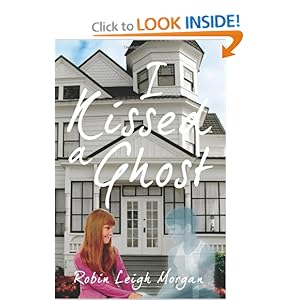
Robin Leigh Morgan has published her first book--and some of us know exactly how that feels...Exciting, scary and altogether NEW. The book? I Kissed a Ghost.
Some of us who have chosen to write
fiction come from a variety of places. And by a variety of places I'm not
referring to a physical location, I'm referring to our writing experiences.
There are some of us who have enjoyed
writing since we were a child, and each year by writing something in school it
improved. For some of us, it continued until we graduated college and began
working. Some of us entered the work force taking jobs which required us to
write, whether it was procedures, handbooks/manuals, or news stories. But all
of these are non-fiction, and each one has a set of "rules" which
need to be followed to write something well enough to be acceptable.
As for myself, while my regular job
did not require me to write, for eleven years I wrote articles
[commentaries/viewpoints] of what was happening in my community and my feelings
about it. When I started to write these items my writing skills were not honed,
I didn’t have my ideas organized in a tight manner, although my writing had
been informative.By the time I’d
written my last item, I’d become quite adept at it.
When
I started to write fiction, I somehow drifted to writing a contemporary romance
story with a paranormal element running through the storyline, but after almost
9 years I still hadn’t completed it. That is, until someone suggested I should
write for a much younger audience; which is what I did, culminating in my first
YA Paranormal/Time Travel/First Kiss romance novel, entitled “I Kissed a
Ghost.”
Anyway, making the transition from
non-fiction to fiction I've had to learn a new set of rules in how to write.
Most of these involved dialogue, showing not telling; where before I just told.
I now had to learn about the use of tags. I had to learn not to be overly
descriptive of something, but allow my reader to create the image for
themselves in their minds. In the beginning I found it hard to break my old writing
habits. Now I'm finding myself with these habits essentially gone. The biggest
issue I still have and am trying to get a good handle on, is POV [Point of
View]. Regardless of what's happening or being said it has to be in one's
character's perspective, and you can't flip-flop between two characters within
a scene, there needs to be a transition from one character to another.
All these things have helped me mold
myself into the author I’m today. I've also learned there are additional rules
within a genre depending on the sub-genre you've decided to write in. These
rules apply to the dialogue spoken which needs to be true to the time period
you're writing in, as well as how your characters are dressed, and their titles
if any, as is the case with the regencies sub-genre of romance novels.
So as you can see writing is not mere
a string of words you put together, there are rules which need to be followed
if you’re to be well received by your readers.
If you have any questions, I’d love to
hear from you.
In "I Kissed a Ghost", Mary gets a new classmate named Jonathan who’s a
great baseball player and to get on the team, he needs Mary’s help to improve
his grades. Six months later when she learns she’s moving, she decides to give
him something special--a first kiss. Moving into her new home she soon discovers
it has a ghost named George, her age, who takes her on numerous trips to the
past of a hundred years ago. As she meets children her own age, everyone teases
her about her house being haunted, but no one will go inside. Mary likes his
help doing her math homework, writing her reports, and taking her back in time.
George and Mary’s interaction grows and she eventually gives him a quick peck on
his lips while they’re in the past, which is the only place George is a real
boy, for having done something special for her. Can Mary kiss George again at
the special date and time he needs to be kissed? What happens afterwards if she
does? The answers are all in the book!