Showing posts with label writing classes. Show all posts

Wednesday, June 17, 2020

How to Unlock Your Writing Genius

Doors are hard to unlock unless you have the right key.

This is the front door to my office.
(Man, it needs some painting).
I need to use the right key to unlock this door;
not any key will do.

The same is true of your writing genius. Dreaming about being a writer never got anyone anywhere - just ask my brother who has been dreaming about becoming a writer for more years than I can remember. He has great ideas too. Ideas that would sell. But what does he do?

Dream. 

Dreaming is good if you take the time to do something about it. 

Make the time.

"Time waits for no man", the old saying goes, and it doesn't wait for women either. If you want to unlock your writing genius, if you want to learn how to become a writer, even the best writer you can be, then you must make the time. When I first thought about writing as a career I didn't have a lot of money to spend on classes. I couldn't afford to go back to school.

What did I do?

I checked out books at the library. I wrote. I attended a writer's
group.


These are some of my books, and some of the books of other writers I have published
through Idea Creations Press.
None of them would have happened
had I not stayed on the wobbly bike.


Learning how to become a writer is a little like dusting off your bike, getting on the seat, and taking yourself for a ride. You might have peddled a few times before, but not lately, and as your bike wobbles, as you try to gain your balance, you realize you've still got it. You can still ride.

My personal belief? We can all write, but not all of us apply ourselves. The juice is in us, but we don't apply what's already there. 

Write more than you watch television or play games on your phone or...

Writing not only takes time it takes a lot of focused time. You've more than likely heard of morning pages, or writing a page a day - or about 500 words, but what of writing 500 words a day on a particular project? Rather than writing 500 random words that come to you, and then wondering what else you can possibly share later, you're just so exhausted getting it all out, why not use those creative juices right off the bat?

Say you're interested in writing a book about your childhood. Start your day by remembering an event that happened to you. You don't need to start at the beginning, just start with one remembrance. The next day, follow it up with another remembrance, and so on. Once you get enough written, you can then consider how you'd like to organize your book.


My first book was a mixture of true experience
and fiction as Samantha deals with her
parents' divorce.

What if you're interested in writing a novel? One of my favorite techniques is finding a picture, either from a magazine, a painting, or a book that reflects my vision. I look at that thing and start to write whatever comes to me. Will it be the beginning? Probably not. But it will be something. And the next day I can look at it again and see what else comes to mind. I may find my beginning on day three or day ten, but if I use my creative juices the day will come and I will know when my book has begun. And who knows? Those other things I have written may just be chapter three or ten!

Throw negative critiques out. 

Story bashing never helps. "Story helps" do. You will know right away what type you're receiving as you're learning how to become a writer by how you feel. Defensive? Bash. Time for a crying jag? Bash. "I really like this part right here." Help. "That's exactly how I felt as a kid." Help. "What were you trying to say here? I really want to get it." Help.

Negative critiques of your writing, especially in the beginning may create within you a desire to STOP. You will hear them, and when you do, let them go. Pick up your pen. Go to your computer and write. 


I usually write on my computer unless I'm away from home. 

But stay focused. Don't rant. Keep going.

Share your work.

Yep. I know, after hearing that you'll receive negative critiques as you learn how to become a writer, you may not want to share your work with anyone. Do. And continue to share even after the negative critiques, especially when you receive the negative critiques. As a writer, I am still learning, and I have been a published book writer since 2002! I was learning before that as well because I started as a newspaper reporter. 


My first draft on a paper for college
received a C-.
My final, an A as I remember.

I am still learning, and expect to be learning until my dying day. I still share my work. Not everyone likes it. And that's okay. I keep writing, and so should you!




Tuesday, May 6, 2014

What's Up? Answering the Big Questions About Your Writing

Can you be successful at baseball without practicing?

What do you want?

Have you ever thought about that question in relation to writing?

I have. And the results are profound.

I don't want to just write for me and all the happiness it gives me, I want to write for others. But I don't want to write about just anything, I want to write something meaningful, and, at the very least, I want to write for fun. Because of this, I don't write particular genres though you can be assured that I write various genres to keep my mind hopping.

Some say writers should write in only one genre. That he/she should focus on that, and when they don't they should come up with a pen name.

I don't agree.
Where does success begin for you? Does it
begin with your first published work, or before
that? 

I want readers to know who I am. And that means when I'm writing Christian fiction and mystery. I want others to see that writers can be multifaceted without confusing their readers. I want them to feel (especially if they have leanings to be a writer themselves) as if they can do the same thing; or at the very least, read various genres of books themselves.

What's up with your writing?

Do you write for you? For others?

Do you believe making lots of money equals writing success?
Are you still trying to find your place in the writing world?

Are you taking classes to perfect your craft?

Are you a new or an established writer trying to figure out how to market your book?

Questions are key to receiving answers, not only about your work, but about you personally, and what you envision for your future.

Friday, April 11, 2014

Marketing Classes to Live For!

Part of what I do here at Idea Creations Press is to provide you not only with material that hopefully helps you write better, publish better, and market better, but I also suggest classes that will be of great benefit to you.

Two such classes are coming up.

Getting Your Book Marketing Off the Ground is sponsored by Writers 4 Literacy and will be held at:

West Valley City Family Fitness Center
May 17 (that's a Saturday)
9:30 a.m.-3:30 p.m.
5415 W. 3100 S. West Valley City, Utah

Speakers will focus on various aspects of marketing. The two my husband and I will be discussing:

How to Make a Book Trailer

"Kathryn Jones spoke at our local writers group last week. Her topic was "Book Trailers." I had no idea what that was--I thought maybe it was the blurb that appears on the back of paperbacks or on the fly flap of hardbacks. Well, I not only learned what a book trailer really was, I also learned a lot more ideas on promoting your books..." (Sharee Hughes, soon to be publishing her first mystery novel).


How to Set Up Your Own Blog

What information should you include on your blog? What should be your blog's backdrop? What should you try to avoid? These questions and more will be answered during the discussion on blogs.

If you've been to a previous speaking engagement of mine on these subjects, plan on attending. Much has changed, even in the past year, and we will be sharing the most up-to-date information on marketing your book. The cost is $45 total for all classes if you register by May 1. $50 after that or at the door.

For more information or to sign up contact Jill Vanderwood at: thewriters4literacy@gmail.com.


The second class will be held during:

The League of Utah Writer's annual Round-Up
September 12 and 13 (that's a Friday and Saturday)
Davis Conference Center
Layton, Utah

No further details are posted yet on the League's site but I'll make sure you get the link when they are. My husband and I will be teaching Marketing Your Book on a Budget, both on Friday and Saturday. League cost for all classes and meals average a little over $100 for both days.

Any questions?

Don't hesitate to leave a comment.


Monday, January 14, 2013

Take a Class

I've probably spoken about classes before, but the direction bears repeating.

Writing classes do multiple things for you:
  • They get you involved with other students and other types of writing. You just may learn something from another student. Students as a rule are at varying writing levels, so some students may learn from you, while you might learn from a more expert student.
  • They connect you with a teacher who cares about you and your work. He/she critiques your work and hopefully gives you ideas on how to improve it.
  • You get the opportunity to vocally share your work. The very best writing classes don't let you hide your writing.
  • You are sometimes able to critique the writing of your classmates, thereby learning a bit about editing.
  • Photo by PalFest, courtesy of Flickr
  • You may get a new idea for a book or short story.
When it comes to taking a class, the amount you pay for it doesn't always reflect what you'll be getting. So check the following things out before you sign up.
  • What has the teacher published? Do their published works reflect what you do? Though it isn't always important for the teacher to write in the same genre, an instructor who writes fantasy will fit in easier with a student who writes fantasy over someone who writes children's books, for example.
  • What is the cap on students? Do you want a more one-on-one opportunity, or would a larger group better suit your needs?
  • Will you critique other students' work, or will your work be primarily from the teacher? I personally like the option of getting a response from other students in the class as well as the thoughts of the teacher.
  • How many weeks is the class? A six to eight week class is great, but if you want to take a college level class, you're looking at a longer period in which you will probably be graded. And, I've said this before, but college level courses, even if they're labeled creative writing or fiction, may not be, so make sure you're in with the write instructor.
Taking a class keeps you writing, and if nothing else, allows you the opportunity to write without giving yourself excuses. Usually classes will have assignments that will be expected to be completed, leaving you little room for ducking out.


Tuesday, January 8, 2013

Writing For Beginners

Are you a beginning writer?

Many years ago I categorized myself as a beginner, and in many ways I still am.

Just 10 years ago I learned about marketing for the first time.
Photo by: Scinern, courtesy of Flickr
And just last year I managed to publish 4 books in one year and open a book publishing service company.

I am still learning. And I hope if you're a beginning writer like I am you'll also take a look at what you've accomplished and what is still to come. Setting goals is vital, but working on them daily is necessary to success.

Being a beginner is not a bad thing. It just means your eyes are wide open to learning new skills.

Have you never taught a class before? I taught my first writing class some 10 years ago, took a break while going to school, and then had to get up on the bicycle again. Tough.

I remember the first writer's group I went to. I was scared...spitless. But I went and shared my work. It was published work but I was still mortified. And I got through it.

Photo by Ned Richards, courtesy of Flickr
Your first book signing (if you haven't had one yet will be thrilling and scary) but after you do it once, it will be that much easier the next time. Your interview on the radio will be difficult, but you will find that after it's over that it was easier than you thought.

Are you a beginning writer?

I hope so.

Friday, February 17, 2012

Getting the Most from a Writing Class

Considering taking a writing class to perfect your writing skills? Getting one that will really help you to move forward may not be as easy as you think.

I took various writing classes when I attended college but they were usually a far cry different than the night classes offered by my local high school. The money spent on the class did not always reflect the type of education given.

Photo by: The Wu's Photo Land, courtesy of Flickr 

Let me explain what I mean. If I took a college class in fiction, I did not always get a class in fiction as most of us look at it; rather, the class was literary in its design. College writing did not always connect with the average paperback novel. And that created some problems for me.

Though I enjoyed much of my college experience, especially those where creative writing was involved, as a rule I have usually favored the night classes I have taken through my local high school or the monthly critique group I have joined. This isn't because most of my college professors weren't proficient in what they taught, rather, the writing I did didn't always reflect the kind of writing I enjoyed or the writing the professors wanted.

A writing class needs to focus on those areas you need help with and the professor or other instructor needs to understand the type of writing you do. For this reason I try to find out as much about the teacher as I can before signing up for the class. I want to know the teacher's focus. Will it be on grammar, novel writing, plot, characterization, critiques, or what? I like to know before I step into the class if the class is best suited to the beginner, intermediate or experienced writer.

Do the writers need to be published? If not, a different group of writers will be sitting in the class. Will the instructor focus primarily on fiction or non-fiction writing? Will it be on novels or short stories?

It's important to ask all the questions before you go into a class and find that it's found wanting. One thing I have done if I'm not sure about the class is to go to the first one before paying for the entire enchilada.

And when I can't do that, I find someone who has taken the class before to share with me what they liked about it. I also do my research and find out how long the teacher has been teaching, or what works the teacher has published.

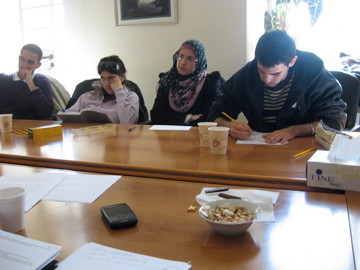
Getting the most from a writing class means more than taking great notes--it's an opportunity to get to know other writers and to learn from them. Critique classes are also a big help because you are able to practice up on your own editing skills (or lack of them) in behalf of someone else. You are also able to get real feedback from those who read your work.

Attend the class you've signed up for as often as you can and make sure you get contact information from those class members that you connect with. Great critique groups have come from such a union.


Tuesday, January 3, 2012

7 Ideas to Begin your own Writer's Critique Group

It's that time of year to start new things and get extra motivated about writing! Can't find a writer's critique group that meets close to you or provides what you need for your writing?

Photo by Julie Jordan Scott, courtesy of Flickr
Why not get going with a critique group that you have created yourself?

I love the idea of creating what works for us because there will always be things that we need that others will need too; plus, we can be in charge of our ideas instead of sitting back and doing what an already established group has done for years. We can gather the people that write what we write and we can gear our critiquing sessions to our own style.

Sound fun?

Here's a list of ideas to get you started on your own critique group followed by a critique group that I am starting up:

1. Get on your favorite networking sites and let others know what specific genre your interested in writing. It's always good to meet with others who enjoy writing what you like to write. Get some feedback on the days and times that work best. You're not going to please everyone, but deciding on a day and time early on will help others to make the decision whether or not to gather with you.

Photo by Wootango01, courtesy of Flickr

2. Will you be gathering online or in person? Online groups are very popular simply because days and times are not necessary to getting a good group together. Online is great for super busy people, but something is usually lacking in connection when it comes to critiquing work. I prefer the in-person approach because  you get a greater sense of personality, quirks and writing style when you are able to converse with the person in a live situation. The only caveat to the online choice is if you are able to talk to each other in real time and through the use of a computer camera.

3. Keep your group small and manageable. Something strange happens when the numbers reach 7 or more. Suddenly, time is lacking and the time you spend has become a free-for-all. My favorite number is 5 because no one gets paired up, and there is just enough writers to handle some heavy critiquing without anyone feeling left out.

4. Create a critique sheet that you'll use when critiquing others work. My critique sheet is a compilation of what others have done and what I've found that works for me.


CRITIQUE SHEET for

_____________________________
(Name of writing piece)

Rate the story from 1-10, 1 being, “More work is needed,” 10 being, “Excellent”.

The Whole Truth

How well was the emotional experience translated onto paper?  Did you feel with the writer?  Did their imagination run free? 
1_______________________10

Where are you?

Did you feel like the story was trying to impress you, or was the story real and at its best?  Was it the writer’s own language, own rhythm, own story? 
1_______________________10

Point of View

Could you see more than one point of view?  Did the writer’s point of view help you to see something in a new way?
1_______________________10

Dialogue

Was the dialogue true and realistic?
1_______________________10

Details  

Is the setting beyond the ordinary?  Do you feel like you are there?
1_______________________10

Five Senses

How did the writer handle the five senses?  (Did you smell the baking cinnamon?  Taste the chilling air?)
1_______________________10

The Whole Truth

Was the ending natural and not forced?  Did the story feel complete?
1_______________________10


Total points__________
                   

*Additional comments to help the writer: (Use back of page if needed).

This critique sheet is taken home with the writing that I'll be critiquing and returned with the manuscript the next time we meet. More general critiques are given when the person reads their work at the meeting itself. 

For example, someone might read their short story at the critique group, and the group would give general comments about characters, plot and a general feel of the piece. Another person would read their piece followed by general critiques. Following each reading a member would take another member's work home and critique it with the form above (or other you may choose to use). The following meeting time the story would be returned with the written critique attached. At this time questions and concerns would be addressed about what was written on the sheet followed by the reading of something new.

5. Keep the reading to 5 pages each for 5 members. Make sure everyone double spaces their work so that the time spent on reading is the same. You may even want to set an egg timer to make sure that everyone keeps to the same amount of time. Keep the meeting under 2 hours. Anything longer and you'll lose people.

6. Where are your writing skills? You may want to start a beginning writer group, an intermediate group or an advanced writer group. An advanced writer group would include published writers only. Of course, mixing your group up a bit allows for writers at different levels to help each other. If you are a beginning writer yourself, you might want to invest in a least one or two intermediate or advanced writers that can help bring the level of writing up within your group.

7. Never be afraid to fail. There will be quirks that need to be worked out as you go, writers that will not work out with your group that will have to be let-go, stuff that you will have to change or revise. This is okay. Eventually you'll have the critique writing group of your dreams; one that has evolved through the varying ideas and people that have become a part of your group.

I AM STARTING UP MY OWN CRITIQUE GROUP FOR NON-FICTION AND FICTION BOOK WRITERS. YOU CAN BE AT ANY LEVEL, BUT YOU NEED TO BE SERIOUS ABOUT YOUR WORK! Writing will not be a hobby for you but a career! The critique group will meet at my home in Bountiful, Utah but I haven't yet decided on a day and time. What works best for you?

Reply to this email with your suggestions and comments. I welcome them!

Kathryn


Thursday, November 10, 2011

Get Smart!

Get smart about your writing! Take yourself seriously!

When I was a beginning writer I should have had business cards made up to promote myself as a writer! Instead, I snuggled under my down comforter and wrote my heart out. I didn't see myself as a writer then, just a writing fanatic. I wrote whenever I got the muse and this satisfied me. My husband knew that I was a writer, but I didn't share my dream with others.

This was a mistake!

Today I tell my writing clients to create a business card with "writer" written on the top, talk about their writing to anyone who will listen, take writing classes where they can meet other writers and get their work seen, start a blog; in other words, get the word out!

The best way for others to see that you're a writer is for you to believe it first. If you have to write it up on paper for you to say every day, do it! If you have to look in the mirror and say, "I am a writer," fifty times, do it! No more excuses for you today. Today is the first day of your "get smart" writing career.