Showing posts with label short story. Show all posts

Thursday, June 29, 2023

Charmed - I'm Sure

Photo by Taton Moïse on Unsplash


Ms. Ratisha O’Neil didn’t live on planet Earth. She lived far away from it, so far you couldn’t smell her smell or taste the air that she breathed, and maybe that was better. Let’s just say Ratisha was an uncommon girl.

Now, before you begin to judge Ratisha unkindly, you need to know something about her, or perhaps, the place in which she lived that made her the way she was.

Rat not only lived far away but on a planet that was so charming – so perfect – that everyone wanted to visit. One person had finally found his way there fifty years previous, only to find that he was not able to leave it.

Before I continue too far with the story, you need to know that when Rat was born, she looked like every other child born on the planet Charmed. She had darling curly hair, bright eyes, and a smile with dimples on both cheeks. She had smooth skin, tiny feet, and hands, and plenty of love to give.

No, she didn’t even cry, for no baby cried on the planet Charmed. Yes, she did all of the other bodily functions, but she was easy to clean up and didn’t require long nights walking the nursery floor.

But one day, something terrible happened – so terrible I didn’t at first want to tell you what it was. But then I figured, if one day, you decided to travel like the young man who was now old to the planet Charmed, you’d know what to expect.

One day, when the young man was walking the streets searching for a way home to planet Earth – something no one could understand because they were perfectly happy where they were – he stumbled upon Ratisha O’Neil. And so you don’t misunderstand, when I say, stumbled, I literally mean he tripped.

No one had stumbled before on planet Charmed. No one had said a heated word. No one had said anything but kind words since the beginning of time.

But this day, everything changed.

“Ouch!” Rat said.

“My foot!” shouted the man whose name was Glen. Glen was a common name and he hated it for his last name was Smith and his shoe size was a common ten and a half, and for a man that was pretty common.

Rat looked up. At first, all Glen could see was mud. It covered everything. Hair. Face. Shoulders. Legs. Even toes.

“Quick! The hose!”

“What are you doing?” asked Glen, mortified, for he hadn’t seen a dirty, unkept creature for many years. He hadn’t even remembered that dirt could make such a horrible, frightful mess.

The garden hose was a typical green. He lifted it and handed it to the mud-covered thing.

“The water, the water!”

In the back of his mind, Glen remembered where the turn-on valve was located – on the house. He reached for it and turned the knob to the left. In a whoosh, water spurted forth.

“Turn it down!”

Glen turned the knob to the right. “How’s this?” he asked.

“Better. But now it’s going to take me longer to dry,” said the girl, for suddenly Glen could see that it was a girl. She had long hair and was wearing a dress that was quickly turning a bright and sunny yellow. She wore no shoes or socks.

“I’m going to be in so much trouble! Just yesterday Mother caught me picking my nose. She told me I could not return to school if I continued to pick it.”

Glen laughed. He watched as the once dirty girl became cleaner, though it was obvious she had wallowed in the mud for some time; there were patches of dirt that appeared ground-in on her mostly-cleaned dress.

She turned, dripping before him.

“How is it that your mother lets you play in the dirt?” he asked, trying to remain calm. His heart pounded like a great thunderstorm and it was all he could do to act casual. Never, in all of the years he’d been trapped on this planet, had he seen anything to rival the appearance of this girl.

“What is your name?” he asked.

Mud squeezed through her toes as she turned off the water.

“Have you seen my shoes?” she asked.

“No.”

“After I dry, I’ll have to go inside. I’ll have to wash my dress the rest of the way without Mother seeing me.”

“How will you do that?”

“I have no idea, but maybe I can get away with it. I’ve gone in with dirty clothes before. Mother doesn’t like it much, but she is getting used to it. I’m Ratisha O’Neil but you can call me Rat.”

A sudden thought struck Glen. He’d known of rats once. He’d had one as a pet, and then it had escaped and Mother had never bought him another one.

“Who named you?” he couldn’t help asking, for he couldn’t see how such a perfect society as this one would know of such a name.

“My mother is wont to grow radishes.”

“But that’s rad,” he said, “not rat. Do you mean Radisha?”

“No. It’s Ratisha. My father re-named me. He’s an astronaut of sorts...”

If you've read down this far you are probably thinking, that's not the end, is it? No, it's not the end. What do you think? Is it a children's book, or something like a pre-teen story? I know it's science/fantasy, but that's as far as I've gone with the genre.


Monday, April 3, 2017

AUTHOR INTERVIEW: T S Blakely

1.     Tell me a about yourself. What got you started in writing?

I began my writing career about five years ago producing business books. As a globally recognized expert in certain business topics and with no information readily available for others, I felt the need to share what I know. It is now five years later and I felt the desire to leave the business books behind and to try my hand at fiction and self-help stories…with the same motivation to help people and the additional motivation to entertain.


2.     How do you schedule your writing time? When do you write?

Mostly of my writing is done at night after the sun goes down. The darkness produces a quiet calm in which to think.

3.     How and where do you write? Do you prefer a lap top or some other method of getting your words down?

I write using a standard keyboard and monitor attached to my laptop. Comfort us key when you’re about to type thousands of words! For my next book, I am going to try speech recognition.

4.     What's your favorite part about writing? Your least favorite part about writing?

My favorite part is in the beginning when I am planning out the story, who the characters are and whether those characters will help or hinder my main character. My least favorite part is the vast amount of time it takes me to physically type up what I’ve planned.

5.     How did you come up with your book idea? How long did it take you to write your book?

It took two months, on and off to write my book. That includes both the planning and writing phase. Of course now, the marketing plan takes even longer! The idea came to me one day after years of watching everyday people struggle. My first book, a short story, is a self-help story for those that struggle to make financial decisions. My second book is a who-done-it story requested by a friend.


6.     What types of marketing do you do to promote your writing?

After conducting a great deal of research on book marketing, I quickly discovered that marketing fiction is very different than marketing my business books. Business book marketing is all about speaking publically at professional conferences. As a new author in the fictional space, I plan to seek book reviewers and interviewers. I may invest some monetary budget to advertising as well.

7.     What are you currently working on? Do you have a new book out?

My first story, the self-help short story is called “Choose Another Road.”


My latest book (short book / long story J ) is called “Bang! Bang! Bang!,” a story about a woman who is pulled out of her quiet life and forced to act in order to protect her impending success.


8.     Do you have a project on the back burner? Tell me about it.

With two stories on Amazon, I am now planning out ideas for a third plot. However, before I write a third book, I will watch Amazon for reader reviews in order to see what people did and did not enjoy.

9.     What would you tell a beginning writer who wants to publish but doesn't believe he/she has enough talent?

There’s only one way to find out! Find people who don’t know you and have then read your work. Your friends and family will always tell you your work is good. Instead, you need to seek the absolutely honest feedback from people without bias.

***


***

Question for Me:

How did you determine what type of book you would write? Did you research to see which genre was the most popular or did you write on topics that were the most comfortable for you?

I began writing because I had to get my story down. My parents divorced when I was seven and I wrote a fictional novel about a girl named Samantha who went through a similar struggle. Even though some of the situations and people were different, what happens within Samantha's heart draws closely to the feelings I had as a child.

Everything I have written has come because of my desires; not because of what is currently selling. For me, making money comes second to touching someone's life or bringing them joy.


Wednesday, February 18, 2015

AUTHOR INTERVIEW: Jessica Parker author of True Sight from the book: Secrets and Doors

Tell me a about yourself. What got you started in writing?

Growing up I loved creative writing in school. My stories would be about witches, princesses, pirates and more. When a friend of mine said she was teaching how to become an author, I jumped at the chance.

How and where do you write? Do you prefer a lap top or do you prefer writing freehand?

I mostly write at home. I write mostly on a laptop because I can type faster. However I have multiple notebooks I use to brainstorm or flush out scenes when I'm not at home.

What's your favorite part about writing? Your least favorite part about writing?

Favorite: the spark of inspiration. That moment when the concept of a story takes form.

Least favorite: revising. It's necessary but there comes a point where I don't want to look at my story anymore.

How do you come up with your characters? Why would readers want to get to know them?

The characters in True Sight, found in Secrets and Doors, were created in response to the idea of a magical objects creation. Who would make the item, what would they go through, and why. I hope readers will find the characters aren't always what they seem. What you see as the right thing can be deceiving.
 
At Amazon
What types of marketing do you do to promote your writing?

I'll be honest, I'm new to marketing my writing. I prefer talking to people about books. However you can find me on my blog: https://jessicaparkerstories.wordpress.com/

How do you schedule your writing time? When do you write? Right now I write late at night. This way if I'm on a roll, there are less interruptions.

What are you currently working on? Do you have a new book out? I'm working on the sequel to True Sight.

Do you have a project on the back burner? Tell me about it.

I have an epic fantasy novel on hold. I need to refine my skills to do this story justice.

What would you tell a beginning writer who wants to publish but doesn't believe he/she has enough talent?

No one can tell a story the way you can. Learn your options for publication and find what is best for you and your story. Then be willing to go to work.

***
Thank you, Jessica!

Learn more about Jessica:


Twitter: @jparkerstories 

Facebook: Facebook.com/JessicaParkerStories

Monday, February 16, 2015

AUTHOR INTERVIEW: Johnny Worthen author of Eleanor and other works of fiction

Tell me a about yourself. What got you started in writing?

All my adult life, I've always written, not always fiction, but always something. It was a common thread through my college work and a theme underlying all of my career moves. No matter what I did, I found ways to write. Newsletters, memos, technical manuals, websites, I've always loved language. The choice to dedicate myself completely to the craft of fiction happened when the opportunity presented itself and I grabbed onto the theme of my life and have held on ever since.

How and where do you write? Do you prefer a lap top or do you prefer writing freehand?


My handwriting is illegible most of the time. It was bad to begin with and then I  learned shorthand in high school. That killed it. I write on a Macintosh computer laptop which is an extension of myself. I can’t live without. I use Scrivener and Pages. I hate Microsoft Word with a burning passion that could smelt the one ring to molten magma. I keep a notepad next to my bed at night with a lighted pen and I’m never without a notebook in my pocket. I jot down ideas as they come and hope later to be able to decipher them.

What's your favorite part about writing? Your least favorite part about writing? 

I love it when my characters take over the story and I just take dictation. That’s cool. Also, the final moment when I know I have the story is a rush equal to any drug I've ever tried. That’s amazing. Holding a book in your hands can only be compared to holding a child and having people talk to me about my story is like visiting with old friends. All wonderful perks.

The rejection is the worst part of writing. For now at least, I’m my own agent and every day is another round of rejections. I have many stories I’m shopping in many different genres and the net is wide and the catch poor. The rejections can and do erode one’s enthusiasm for the craft.

How do you come up with your characters? Why would readers want to get to know them?

My characters are the center of my stories. My working titles are invariably the character’s name. The story and the character are like co-orbiting stars in my mind each dependent upon the other for existence. They form together and will live and die together. When I get a story idea the character is born simultaneously.

I’d like to think that readers would like to get to my characters because they’re interesting and realistic. My characters all have faults, some bigger than others. They struggle with the same problems we all work through in our lives. I exaggerate the troubles and intensify the situations, but at the heart of my characters and my stories are real complicated questions and thematic challenges we can all related to.

What types of marketing do you do to promote your writing?

Whatever I can. I’m active on social media and I’ll never turn down any opportunity to talk to writers, readers, bums, serial killers, anybody. I’m naturally outgoing and usually find a way to mention my books. That’s the most effective way I've found to market, one on one. I've used publicists and they've done some work for me with blog tours and book signings, those are cool. Book signings are good when people are waiting for your book, but I’m not quite that big yet. What they turn into for me is a chance for a one on one conversation. My enthusiasm for my books is contagious. I spread the disease as far as I can. Also, I adore writers and try never to miss a conference or symposium. I love presenting and I love learning and I love talking. That’s a bit of networking which might be a kind of marketing, but it’s mostly just fun. When it’s fun, I don’t think of it as work, which marketing undoubtedly is.

How do you schedule your writing time? When do you write?

My most productive writing happens in a dark little coffee shop near my house. It’s good to get away from distractions, but more often than not, I’m on my couch, in my office, or outside. Dark rooms, low or no music works best. Early morning is productive but usually spent with marketing, so I usually write in the nighttime. It varies depending on where in the story I am and what commitments I have. However, I write every day. Every day. Every single day. No exceptions.

What are you currently working on? Do you have a new book out?

This will a big year for me. I have three books coming out – a hat trick. In May I have THE BRAND DEMAND coming from  Cherokee McGhee. It’s a political mystery in the vein of Edward Abbey’s MONKEY WRENCH GANG. In July, Eleanor’s story continues with CELESTE. Fans of the first book are in for a wild time in the second installments of THE UNSEEN TRILOGY. Then, in the Fall, I’m releasing THE FINGER TRAP, a very adult comic noire which puts detective fiction on its head with the introduction of my slacker every-man detective Tony Flaner.

Purchase at Amazon
In the meantime, I’m writing new things. I just finished my twelfth novel, a literary young adult adventure I’m calling ANDI KENDRICK: THINGS BEQUEATHED. I think of her as Eleanor’s plucky younger spiritual sister. I’m also shopping a horror, WHAT IMMORTAL HAND, a dark literary road trip into madness and dark gods. In an homage to the late great Elmore Leonard, I have a fun gritty crime thriller called A BLIND SQUIRREL which I’m selectively shopping to agents as we speak.

Do you have a project on the back burner? Tell me about it.

After my edits of ANDI KENDRICK: THINGS BEQUEATHED, I’m mulling over several possible projects. I've been enthralled with the story of Roanoke and have several angles to approach the major themes I saw in that tragedy. One’s an historical fiction, the other a science fiction. I've never written hard sci-fi before so I’m attracted to that. I also have a black comedy in mind that my kids want me to follow and another young adult mystery with less paranormal and more paranoia. I’ll let you know in February which one I pick up.

Short story collection
at Amazon
What would you tell a beginning writer who wants to publish but doesn't believe he/she has enough talent?

Practice practice practice and lie to yourself. If you think about the odds, you’ll never pick up a pen. Pick it up believing you will be published, but knowing that every word, sentence, paragraph and story you write will make you better and bring you closer to your goal.

***
Thanks, Johnny!

Learn more about Johnny and his books below:


Friday, August 30, 2013

BOOK REVIEW: Pure Trash

If you remember Orange Crush in bottles, bike rides away from home, slingshots as fine entertainment and Good 'N Plenty's as a way of filling your stomach on a hot summer day, you might be able to relate to Pure Trash by Bette A. Stevens.
Pure Trash can be found at Amazon
 
If you've ever been offended, judged, spoken to in a way that gave you serious room for doubt about the world and the people in it, then you will definitely relate to Pure Trash.
 
Shawn is a poor boy, with a mother who makes her clothing out of old potato sacks and a father who spends most of their hard earned money on beer. But Shawn doesn't know that he is poor. He doesn't know his father is a drunkard. This is his life.

What Shawn knows is that he has a best friend and brother named Willie and that gathering pop bottles and turning them in for cash is the next best thing to being rich.
Shawn creates adventure at every turn and enjoys the simple pleasures of life:

"Flying down the other side (of the hill on a bike) gave me the best feeling in the whole world. I guess that's how that old chicken hawk feels when he soars above the pines at the edge of the field out back of the house."
The short story is filled with images and flavor only better provided by an ice cream cone.

"Dad always said that you 'had to hold your mouth just right,' or the fish wouldn't bite."
"Willie's brown eyes looked as big as Mum's pan friend donuts..."

The interesting thing about being poor as a child is that you rarely know you are poor, unless a Christian or two points out some 'obvious' lack. But even then, life goes on, and you make the best of what you've got.
Because it's all you can do.

I recommend Pure Trash to the adult reader and YA reader alike.

Thursday, May 16, 2013

Weaving Your Story

When you write a story, whether that story is a short story or a novel, something important needs to take place to make your story cohesive and interesting to read.

And that thing is weaving.

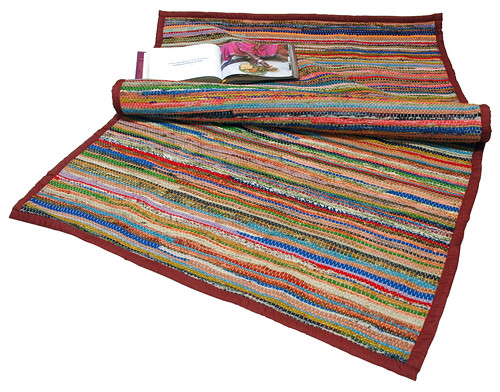
Photo by: New Internationalist, courtesy of Flickr
Like a beautifully constructed rug of color, a story that is woven has two primary elements that are woven throughout the other colors or story elements.

And these two elements are:

Dialogue
Setting

One without the other simply would not work in any short story or novel; especially if you want the reader to continue your story and not stop at page one.

As part of my business is editing, allow me to share a few things I have learned from the authors I have edited.

First, the author is usually strong in either dialogue or setting, and this strength carries throughout the book.

Photo by: Avery Studio, courtesy of Flickr
Two, the weakness of the other will be shallow, yes, just like the shallow end of a great ocean. Where one is beautifully constructed, the other is considerably less so.

Three, many authors write in blocks. They may write a terrific dialogue scene (because this is their strength) then add a snippet of setting, and then there they are again, back to dialogue. Each area is separate and single, though both are in the same story.

Weaving the two simply means that with dialogue, you have setting, and with setting you have some dialogue and that you balance the two throughout your story or book. It can mean that you have quite a bit of setting, but that you break it up with dialogue or thought processes.

Here's an example:

George Mahooney hated flies.  They buzzed around his ears, and pecked leisurely at his withered flesh.  To swat them, was useless, and spent energy George didn’t have.  His movements were slower now that he was ninety.  His breath was heavy and tortured.

He arose from his bed, allowing the even breathing of his wife to whisper of past dreams in the already warming room.  They’d spent the majority of their lives here, making love, talking, and arguing about things George no longer remembered.

He kissed her once, taking in the cinnamon scent in her hair and skin.  She always smiled, even in her sleep, and George had always wondered why.

In moments she would awaken and the quiet of the morning would be replaced by her endless singing.  Her quiet hands would busy themselves in the kitchen.  She would make his breakfast: Oatmeal with milk, dry toast and butter, a glass of orange juice and a side order of cinnamon roll.

George walked barefoot into the living room and through the door to the front porch of their country home.  It was the absence of flies he noticed first in the warm August air.  He hadn’t looked at the clock, so he’d probably beaten them awake.

George smiled at his cleverness, and sat down on the old rocker.  He pushed himself forward, then backward, then forward again and watched the birds—they were brown and speckled with dusty tan—unlike the birds of yesterday that came every day in the summer to peck at his overgrown fruit trees (From The Awakening of George Mahooney, a short story).

Is there actual dialogue in this sample? No, but there is plenty of thought process, and that's what's important here.

Here's another example with obvious dialogue:

I nodded my head. Very slowly, Joshua released his hand from over my mouth. Spit had accumulated on his hand, and he wiped it against his Levi’s. I smiled inwardly.

“We’re going to play cowboys and Indians,” Luke reported. “You’re the squaw.”

“OK,” I said. “What do I do?”

Luke grinned, his large teeth glistening in the afternoon air. “Come with me,” he said. “I’m the chief.” He turned and strode away, Joshua sandwiching me between them.

I almost laughed. “You gonna take your shirt off?” I asked. Luke had already turned the corner and was probably getting set up for battle. “I don’t know of any Indians who wear shirts.”

“Good idea, squaw,” he said, reaching down with his pudgy fingers. He had the blue cloth over his face when I made my escape. I heard a second of grunting and got a brief glance at Joshua’s fat stomach bouncing before I burst free.

I dashed to the end of the lawn, turned the corner, and ran swiftly to the end of the street. There was no sound from my house. Evidently Joshua was still struggling to get his shirt off  (From, A River of Stones, a YA novel).

What's important here is that I've incorporated both dialogue (or thought processes) in both examples, though the examples are very different.

In my own writing I focus on weaving both setting and dialogue and sometimes have to return and add a bit more setting: dialogue is my strong point.

What's yours?