Showing posts with label dialogue. Show all posts

Monday, June 26, 2017

KEEPING IT REAL: Reality in Writing

Years ago, I watched soap operas like they were going out of style. And I loved them. Everyone had such exciting lives, often, I found that my life was dull in comparison.

It wasn't until later, when the love for soaps dropped out of the picture, that I realized how 'unreal' they actually were, and that, thank heavens, my life wasn't filled with all of that pain - and on a daily basis!

Image result for dialogue
https://www.tes.com/lessons/aUnoFPhKIgHYMg/dialogue
Reality in writing is important, yes, even if you're writing science fiction or fantasy. Maybe espeically then. You reader needs to connect, not only to your characters, but the place they have planted themselves. And your reader can't do that if they are thinking, "well, she just wouldn't say that," or "he wouldn't do that." "That place is just too far-out in space to be believed." "What about science?"

The wrong dialogue can also cause book problems. Even though characters are fiction, they're a lot like real people, and should have some of the same expressions. Make sure that what your characters say not only reflects the time period in which they are living, but the personality you have given them. Make sure that their fears are in check; that your reader doesn't become mystified because your main character is suddenly sounding like your secondary character.

A good excercise; one that I should implement more often, is to write out my dialogue without the tags (i.e., he said she said) and see if another reader can tell who's speaking without the tags. In writing, you need some tags, but they don't need to be after every piece of dialogue. Too many tags will actually slow down the scene. 

No writer is perfect, and I'm still dealing with reality in my own writing, so don't give up if this is a struggle for you. Listen to those critiques, listen at parks, malls, grocery stores. Take notes on how people speak.

It will be the most helpful homework you've ever experienced.

Thursday, April 16, 2015

SNOW? What it has to do with your writing

Have you ever written something that didn't quite - fit?

Is your main character expressing herself in ways she shouldn't? Do you have a particular scene that seems dropped in by some romance author even though your book is science fiction?

I've had this happen and it's a little like the snow we're having in April.


Yes, it snowed yesterday, heavily. My grandchildren were even able to build a fort with it. And although they were enjoying it (I was trying to) I just couldn't get past the fact that it was April and it was snowing like it should have snowed in January.

And I couldn't help it. I thought about writing and all of the times I've had to do a little bit of weeding under the snow.

And it's hard, let me tell you.

But I've learned something important about taking care of it as soon as I see it.

The longer the snow sits, the harder it is to get to the weeds.

If you're finding it hard to weed out that chapter or that line or that scene that doesn't quite 'fit' into your story, think about it this way. You can save it for later. Maybe later you can use it in another book. But even if you don't, the shoveling is still important.

I promise.

Kathryn

Tuesday, July 1, 2014

Making the Most of What You've Got


See how you can use your writing
strengths to overcome your writing
weaknesses


I have always been able to tell a great story, but I wasn't always able to connect the dots on paper. So I practiced until the sentences flowed like water, and the connective tissue was hard to see. This also took time. I read other writers. I wrote. I tried to find my voice by writing what was from my heart more than what I found lurking inside my brain. And in time, through practice, my writing voice came.


Making the most of what you've got is using your gifts and talents in particular avenues of writing to help you along with those areas in which you lack. And you have to have some things you do well, or you wouldn't be a writer in the first place.
Make a list of your writing strengths

As writers we're constantly coming across stuff we wish we could do better. For me, some of the stuff I'm still working on is setting.

Setting for me is kind of like poetry. It's a place you go, beyond great dialogue and a terrific plot, to round out your story and make it believable. The last thing a writer wants is for the characters to be standing in some sort of void.

And yet, setting is where I struggle. After all of the writing and editing, I am always going back to add more setting to a scene, and even then, my books are never high in setting; I focus more on what I do best.

As a good writer should.

For example, maybe you're better at setting, and lack in dialogue.
Or maybe you can come up with a terrific plot, but have a hard time connecting chapters or paragraphs.

Whatever your dilemma, be assured that your writing strengths were given to you for a reason. To help you to write. But that's not all. They were given to help you to
overcome your writing weaknesses.


A case in point.

If I'd stopped in the beginning because my stories never sounded as good on paper as they sounded when spoken aloud, I'd never be where I am today. I used what I had: the telling of a great story and all of the imagination that came with it, and connected the gift with the weakness: writing it down on paper.

And I continue to grow my weaknesses through the use of my strengths as I'm sure you do, whether you know you are doing it--or not.

Wednesday, January 22, 2014

Do Your Characters Speak to You? Do You Listen?


I had a great conversation recently was a fellow author about characterization, and the importance of making their fictitious characters REAL.

What makes a character real? I asked.

I suppose they are like the rest of us, was the answer. They say the right things based on their likes and dislikes; perhaps where they sit in a family situation, whether first or fifth in line. They do the right things. You can count on them to visit particular places and settings.

Photo by: Menage a Moi, courtesy of Flickr

So what happens when your character doesn't feel like that to you?
I asked.

Well, you're probably not listening to them them, he answered.

Listen to a character?

You bet.

Have you ever been writing along merrily, when suddenly what you have written seems awkward, almost forced?

I have.

And the best thing I can do is to stop and take notice. The scene I have just written, does it run true for the character, or am I forcing the character into a place he/she wouldn't really go?

Is the character speaking like themselves, or like me? Do I want the character to say something so bad I forget that the character might just feel differently about that?

Okay, so maybe we writers are a little bit crazy. I'm almost saying here that we hear voices... but I want you to reflect on the last time you wrote dialogue.

Did you listen?

Was it more important to get the feelings of the character authentic over your agenda for them?

There's something soothing and yes, REAL about a character who appears real on paper because we've remembered to listen.

So listen...

Thursday, May 16, 2013

Weaving Your Story

When you write a story, whether that story is a short story or a novel, something important needs to take place to make your story cohesive and interesting to read.

And that thing is weaving.

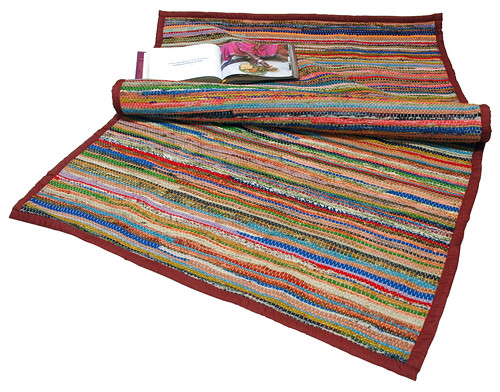
Photo by: New Internationalist, courtesy of Flickr
Like a beautifully constructed rug of color, a story that is woven has two primary elements that are woven throughout the other colors or story elements.

And these two elements are:

Dialogue
Setting

One without the other simply would not work in any short story or novel; especially if you want the reader to continue your story and not stop at page one.

As part of my business is editing, allow me to share a few things I have learned from the authors I have edited.

First, the author is usually strong in either dialogue or setting, and this strength carries throughout the book.

Photo by: Avery Studio, courtesy of Flickr
Two, the weakness of the other will be shallow, yes, just like the shallow end of a great ocean. Where one is beautifully constructed, the other is considerably less so.

Three, many authors write in blocks. They may write a terrific dialogue scene (because this is their strength) then add a snippet of setting, and then there they are again, back to dialogue. Each area is separate and single, though both are in the same story.

Weaving the two simply means that with dialogue, you have setting, and with setting you have some dialogue and that you balance the two throughout your story or book. It can mean that you have quite a bit of setting, but that you break it up with dialogue or thought processes.

Here's an example:

George Mahooney hated flies.  They buzzed around his ears, and pecked leisurely at his withered flesh.  To swat them, was useless, and spent energy George didn’t have.  His movements were slower now that he was ninety.  His breath was heavy and tortured.

He arose from his bed, allowing the even breathing of his wife to whisper of past dreams in the already warming room.  They’d spent the majority of their lives here, making love, talking, and arguing about things George no longer remembered.

He kissed her once, taking in the cinnamon scent in her hair and skin.  She always smiled, even in her sleep, and George had always wondered why.

In moments she would awaken and the quiet of the morning would be replaced by her endless singing.  Her quiet hands would busy themselves in the kitchen.  She would make his breakfast: Oatmeal with milk, dry toast and butter, a glass of orange juice and a side order of cinnamon roll.

George walked barefoot into the living room and through the door to the front porch of their country home.  It was the absence of flies he noticed first in the warm August air.  He hadn’t looked at the clock, so he’d probably beaten them awake.

George smiled at his cleverness, and sat down on the old rocker.  He pushed himself forward, then backward, then forward again and watched the birds—they were brown and speckled with dusty tan—unlike the birds of yesterday that came every day in the summer to peck at his overgrown fruit trees (From The Awakening of George Mahooney, a short story).

Is there actual dialogue in this sample? No, but there is plenty of thought process, and that's what's important here.

Here's another example with obvious dialogue:

I nodded my head. Very slowly, Joshua released his hand from over my mouth. Spit had accumulated on his hand, and he wiped it against his Levi’s. I smiled inwardly.

“We’re going to play cowboys and Indians,” Luke reported. “You’re the squaw.”

“OK,” I said. “What do I do?”

Luke grinned, his large teeth glistening in the afternoon air. “Come with me,” he said. “I’m the chief.” He turned and strode away, Joshua sandwiching me between them.

I almost laughed. “You gonna take your shirt off?” I asked. Luke had already turned the corner and was probably getting set up for battle. “I don’t know of any Indians who wear shirts.”

“Good idea, squaw,” he said, reaching down with his pudgy fingers. He had the blue cloth over his face when I made my escape. I heard a second of grunting and got a brief glance at Joshua’s fat stomach bouncing before I burst free.

I dashed to the end of the lawn, turned the corner, and ran swiftly to the end of the street. There was no sound from my house. Evidently Joshua was still struggling to get his shirt off  (From, A River of Stones, a YA novel).

What's important here is that I've incorporated both dialogue (or thought processes) in both examples, though the examples are very different.

In my own writing I focus on weaving both setting and dialogue and sometimes have to return and add a bit more setting: dialogue is my strong point.

What's yours?


Friday, March 15, 2013

Facebook Friday Video, Dialogue

Facebook Friday Video number 2 is not my of own creation. It comes from Nadia Kalman. The title is: Three anti-social skills to improve your writing.

Find it here:

http://www.youtube.com/watch?v=flthk8SNiiE

Listen to a conversation on the bus.
Photo by: momentcaptured1, courtesy of Flickr


Have some fun with this and let me know what you think!

Saturday, March 2, 2013

Is Your Setting Hiding Behind a Bush?

What about setting?

Does your dialogue take over; so much so that you have no idea where your characters are standing, what colors surround them, how it smells in the summer where they are standing?

Yes, for some of us, using setting is sort of like plucking our eyebrows, either we do too much or we do too little.

What do you think this woman is saying to herself? What does the setting reveal?
Photo by: titoy', courtesy of Flickr
Here's how to balance it.

Start with what you do best. If it's dialogue, go at it. Get those characters speaking. If it's setting, get it all out; the smell of the grapes, the taste of the watermelon, how the light flickers off of  her hair, but get it out.

Now, after you've finished with your chapter, go back and fill in the gaps. You'll know where they are. Either you'll have dialogue with characters sort of floating somewhere, or you'll have tons of setting that is beautifully written but that really doesn't move your story along. Read what you've written out loud and make adjustments.

If you find that your dialogue and setting is fairly balanced, good for you! Go on to chapter 2. Continue the process until your book is finished.

If you need some help with dialogue: Record some dialogue at a restaurant you're at, in the bus or at a park. Play it back at home. Notice how people really speak and incorporate that into your story.

If you struggle with setting: Cut out some pictures from a magazine. Use them in a binder and when you feel the block coming on, open up the binder and choose a photo to write about.
Your setting might be beautiful, but is it too much?
Photo by: thekeithhall, courtesy of Flickr

You don't want your setting to get lost behind a bush, but neither do you want it to stand out like a sore thumb. You want readers to finish your book, not get bogged down because of all of the setting details.

I'm done. Now have some fun.

Wednesday, January 30, 2013

Dialogue that's Real


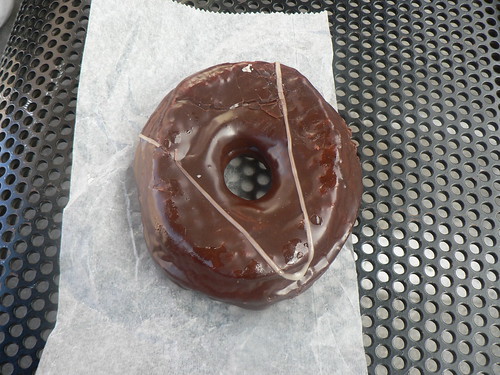
I don't know about you, but having a great conversation is the next best thing to eating a chocolate doughnut. I love to talk, and I love to listen, and I love words (no surprise there).

Photo by: stu_spivack, courtesy of Flickr
Dialogue comes in all shapes and sizes in real life just like it should come in the real world called our latest novel. But sometimes, (dare I say it?) we find that our book dialogue is stilted, untrue, long-winded, boring, and altogether unrealistic.

Yes, real life dialogue can run the same gamut, but usually it's real enough in getting us to continue with our conversation. If the conversation turns sour we usually stop speaking, leave the room, or speak with someone else in the group.

Unfortunately, in a novel, we really can't stop speaking. (There's something about pure setting that really bores the reader). We can't leave the room (because again we're looking around at the pretty rose bushes in the charming garden of our main character for all time) and we can speak to someone else in the group I suppose, though the main character will still need to speak at some point in our novel.

What we can do is to create real dialogue in the first place instead of something else. And that takes practice.

Here are some helps:
  • Consider a real conversation and base your book dialogue off of that. What do people really say? "I can't believe it! Are you serious?" or do they say, "I am full of disbelief. You are talking to me like you're not very serious"?
I hope you chose the first option. No one I know says, "I am full of disbelief. You are talking to me like you're not very serious."
  • Consider the actions that accompany the dialogue. "I can't believe it! Are you serious?" Charly tugged at her shirt, trying to cover up the offending navel. Or, "I am full of disbelief. You are talking to me like you're not very serious." Charly thought her friend didn't understand about the latest styles. She liked the style.  
Just say it without saying everything. Your reader will figure it out if you say it without so many superfluous 'explaining' words. We know in the first instance that Charly was wearing a shirt that showed her navel. We also know that her friend was 'offended' by it.
  • Consider how often you use dialogue. I have said this before but it bears repeating. A great book has a mixture of dialogue and setting; one doesn't overrun the other, though dialogue usually plays a slightly higher hand than setting. Look over a page of your writing. Do you have more dialogue or more setting? Dialogue will keep your writing clipping along; setting gives it more of a pause. Let me put it this way: Have you ever skipped long winded setting to get to the next piece of dialogue?
In the end, dialogue that is real takes the pressure off your readers. Instead of hoping your story gets better, they can't wait to find out what happens next.


Tuesday, October 30, 2012

Come and Stay Awhile: The Importance of Setting

I don't know about you, but setting is harder for me to tackle in a novel, especially if I haven't been to the place I'm writing about. And even if I have, there's still that stuff I need to check out.

I have been on a cruise, but I didn't know what happened behind the scenes. I didn't know what the captain's quarters looked like or where the food was stored. I had questions about crew cabins, jobs on a cruise ship, and what happens when someone dies on board.

Yes, this means I did some research for my book, Sunny Side-Up, though I could draw on my experience as a passenger to complete the setting.

Setting is a valuable asset to your book or short story, because with setting you get a feeling for where the characters are standing and participating. You aren't in some void, rather, the setting contributes to the characters in the book and vice versa.

Photo by: CJ Isherwood, courtesy of Flickr
San Francisco
Photo by: Dougtone, courtesy of Flicker
New Jersey
In my first mystery, Scrambled, the people living in the Hotel Camaro reflected the condition of the hotel itself, which was badly in need of renovation. And since I'd never stepped foot in an old east coast hotel, I had to do some studying to make the setting right. I couldn't just use what I remembered about San Francisco to make it right, for example.

Setting isn't just about tree placement, or having a garden or making the sky blue, the setting reflects the story in a very real way and contributes to your character's success.

You want your reader to put of their feet and stay awhile. But you don't want them to get too comfortable. That's why there's tension and conflict to balance out the beautiful trees and meandering stream. That's why the old hotel with loosening bathroom fixtures, still has room to show it's beautiful wooden cornices.

Though a huge dose of setting at any given time is usually skipped over by the reader, a sprinkling of it in between dialogue lends depth and interest to your story. Are people talking all of the time? Even in real life there is time for reflection and quietness. And that's what you want in your story.

You want your reader to see the world that the character lives in. You want your reader to know why they live where they do, and how the world in which they live contributes to their happiness or lack of it.

If you can do this, your readers will want to prop up their feet and stay awhile.

Thursday, October 18, 2012

Writing a Screenplay?

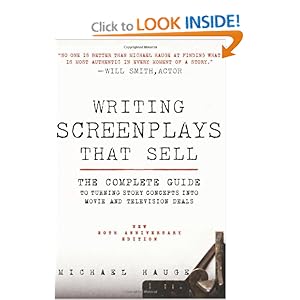
I absolutely LOVE the book, "Writing Screenplays that Sell," by Michael Hauge!

Writing Screenplays That Sell, New Twentieth Anniversary Edition: The Complete Guide to Turning Story Concepts into Movie and Television Deals
http://www.amazon.com/Writing-Screenplays-That-Twentieth-Anniversary/dp/0061791431


How often are you writing a book and you can see the characters in living color inside your head? How often do you wonder if your dialogue is where it should be, or if the story is strong enough to carry the main character to the end? Have you ever considered the importance of theme? Structure? Writing individual scenes?

I have never written a screenplay, but I can tell you when I've seen a good one and when I haven't. Perhaps the end isn't realistic and unbelievable--probably a problem with character development. The scenes jump, and don't flow. Probably a problem with structure.

The cool thing about Hauge is that he analyses the movie we all know and love, The Karate Kid. What made the movie such a success? What elements were important? Did the movie also have weaknesses?

Hauge also discusses the weaknesses of the movie; things such as predictability and a slow beginning.

Can either of these issues relate to a book you are writing?

You bet.

When it comes to writing books I tend to shy away from the punctuation type, unless I have a question that needs to be answered. But often, the best writing books are those that teach you not only how to write with flavor, but how to get an audience interested for life.

Have a favorite book on writing? I would love it if you shared it here.

Kathryn


Wednesday, October 10, 2012

Balancing Dialogue with Setting and Reflection

I received a phone call from a writer this morning. She wanted to know if writing a page and a half of material without dialogue was okay. I assured her that it was.


Photo by: veni  markovski, courtesy of Flickr
There is a place for setting. A place for back story. A place to sum up without spelling out every nuance in a conversation. Because, as usual, your story must move forward.

So when do you know when to write dialogue and when to leave it out?

Only you can answer that question. And your readers, of course. And we're talking here about the readers you get before you put your book out there to the world. They may tell you that:
  • Your story drags too much. You need more dialogue. 
  • There is confusion. The story jumps too much from setting to setting and the reader is having a difficult time understanding where they are.
  • You write too much dialogue and not enough setting.
  • Reflection time takes over the story and is always swimming in a circle but never taking the character anywhere.  
Photo by: LaurenFinkelPhotography, courtesy of Flickr
Writing dialogue is a bit like real life situations. In fact, the best dialogue takes a back seat to the dialogue you use in real life and the power it gives you personally to move on. Dialogue peppered with some reflection time and the use of setting intertwined makes for a great balance in your book. As in book reading, balance is also wanted in life (even if we don't get it).

Because dialogue moves the reader along faster in your story than any other writing medium, you want to make sure you use it; but you also want to give the reader pause for reflection, time to take in their immediate surroundings. There's nothing worse than having your characters standing within an empty void. Your readers want to see where they are; breathe in the air if you will. They want to be a part of the story.

We all have writing areas we are stronger at. Mine happens to be dialogue. I struggle with setting and find that when I return to a book I often have to add a bit more. You may do the same with dialogue.

The good news is that in book writing, a writer can go back and re-do what was said or felt or seen--something not usually possible in real life.

And maybe that's the best news.


Friday, January 6, 2012

The Power of Dialogue


I don't know what it is about dialogue but it connects you with a character faster than plot, setting or any other thing. Maybe that's because we use dialogue in our own connectedness with others. Without dialogue, whether in person or on paper, we're left alone. It's the dialogue that keeps us reading. It's the dialogue we connect with. It's the dialogue that needs to feel just right.


Photo by Ed Yourdon, courtesy of Flickr
Have you ever read a manuscript, perhaps even a book, where the language was stilted, almost--unreal? This is because the writer struggled to find the truth in the dialogue he/she used. Either the writer was trying to impress you or he/she was not able to get a handle on the dialogue itself. 

Let's tackle both of these issues:

  • Beginning writers especially have a problem with trying to impress. If they have not yet found their writer's voice, they will attempt to use the voice of someone else. Finding your voice is not an overnight discovery, finding your voice takes time and a willingness to open yourself up and share your heart. 

My first short story was a real problem. I tried to impress with long and little used words. I wanted to sound smart, like I knew what I was writing; instead I sounded like what I wanted to avoid. But I still keep this short story. It reminds me of where I was, how far I have come, and what to continue to avoid when it comes to dialogue.

  • It is often difficult to write dialogue, especially when you are running against other characters in your book. Before beginning a book I find it helpful to find pictures from a magazine or other source that I can put into a binder along with a list of characteristics about each character. Characters are people and each will have quirks about them and ways of saying certain things that differentiate them from another character. 

Photo by epSos.ed, courtesy of Flickr
If all of your characters sound the same it's a good idea to spend some time listening to people and either recording them or writing down key phrases that catch your eye. Spending time at the mall or on a bus is a great way to hear and record how people speak. Sitting down at the park or spending some time alone at a restaurant will help you to key in to how others speak.

If you remember that characters from a book should be just like the characters you deal with in your "real" life, you will write in characters that are as real as your next door neighbor, your great aunt Marge, or your best friend who thinks others are always staring at her.

And that's something we all want.