Showing posts with label tension. Show all posts

Thursday, March 13, 2014

Tension in Writing

I don't know if I've focused on tension before, but I feel as if the time is now. I don't know what it is about writers, but so many of us avoid adding tension to our work like the plague.

And perhaps that's because we don't want our characters to be in jeopardy.

But they NEED to be in jeopardy!

The reader NEEDS to wonder what is going to happen next!
They need to FEEL that something is not quite right!
The characters, at least the main character, has to be put into problem after problem until the problem is resolved!

All these add tension!

Do you have tension in your life, or is your life smooth sailing?


Tension in writing is sort of like sailing off in a grand boat, thinking that the time away from the shore will be the best thing you've ever done, only to have a storm brew and land you on an uncharted island. How will you get off that island? How will you survive? What will you eat? Where will you sleep?

Tension is needed in every story, whether your story is about a vampire, or a girl who believes she is a vampire but discovers she is really the tooth fairy. (Now, there's an idea for a story...)

What I'm trying to say is that even in a story, which at the forefront appears good and kind and easy going, you're going to have some tension; in other words, a problem that your main character is going to have to work through. And this causes tension.

Ready to take on some tension?

Get writing!

Thursday, August 22, 2013

Don't Tell Me, I Have to Start Over?

I have been working with authors for some time now, and sometimes we learn through the process of editing and improving the manuscript, that the task is really that they need to start their short story over. A book is even worse, and it can be very painful considering all the time and effort put into it. 

But sometimes the task is necessary.

Sometimes, you have terrific characters, a nice setting, but the plot? Well, it sucks.

There is not enough intrigue, not enough tension, not enough (dare I say it) problems in the book to make the reader continue to read until the last page. Or you may have a lot going on in terms of problems, but the problems are all over the place and don't necessarily reflect the main struggle your primary character is going through.

Photo by: @Doug88888, courtesy of Flickr
For example, say your main character's parents are going through a divorce, but the problems your character faces don't specifically stem from the main problem. Perhaps the girl's focus is on friends and getting good grades at school, but she has no problem making friends and her grades are perfect. When a child faces the divorce of her parents, the loss affects every avenue of her life. She struggles to be liked, to prove herself worthy of a friend--any friend. (Who has enough self-esteem to be picky?) She makes mistakes directly related to the divorce, and finds herself searching for answers to fill in the loss of a missing parent.

Yes, I'm well aware that some books don't need that climb up the mountain (such as a memoir, for example) but most books need the intrigue. They need the tension.

Without it, you have nothing but beautiful words that lead the reader to the kitchen for a bite to eat.

Starting over isn't all bad. You have the characters in place. You have the setting. Now, create some problems for the character that continue to get worse (based on the main issue) before they get better.


Thursday, August 8, 2013

Secrets: When You Should Keep Them in Writing

If you're a writer of mystery or suspense, you've probably heard that keeping secrets is the name of the game when it comes to writing in either of these genres. And that's simply because you don't want to spell everything out in the first chapter.

But consider a romance; one that keeps you jumping. Will they ever get back together? Will he ever tell her why he doesn't want to get married?

Sometimes the secret is for the character; the reader knows, at other times, neither the character nor the reader has an inkling of what's going to happen next.


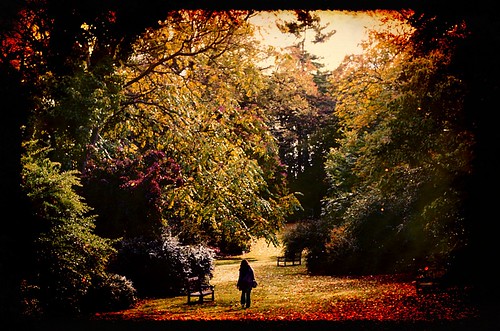
Photo by: @Doug88888, courtesy of Flickr
Why does she come to the park alone?
And that's as it should be.

Consider a novel that spells it all out and never leaves anything to the imagination, or worse, tells you what everyone is thinking and the secrets they've been keeping. Consider knowing it all in the first chapter. Would you want to go on to chapter 2?

Of course not.

Secrets, well kept, still lend themselves to some hints, of course. You want to lead the reader along, probably not by a dog collar, but by a thin thread that keeps them wanting more. The secrets can be between the characters, or the secrets can be between the author and the page. In either case, keeping secrets adds great tension to your story and keeps the interest rising.

Why doesn't he tell her he's been previously married? Why does she act so strangely around cats? What makes him cower whenever he sees a mushroom?

Sometimes secrets are meant to be kept, and when it's time to release them, timing is everything. Like a perfect ending to a less than perfect life, you want your reader to feel rewarded for having spent the time trying to figure it all out.

Thursday, March 28, 2013

How I Write My Books

Often the question is asked, "So how do you write a book? There are so many chapters and so much writing to do, how do you ever get it finished?"

Other questions are usually, "How do you get your ideas," or "How do you keep the story going until the very end?"

Questions like these are valid, but often, they get in the way of sitting down and writing your own book.

When I write a book I do a little research. I don't spend days and days on it, because I've learned that I quickly burn out. After a bit of research I get going on my book. Sure, research will then occur during the process of writing, and I make time for it when the occasion comes up, but I don't make my book about the research, I make the focus about the story.

I usually make a goal of a chapter a week. That way, I have a direction to travel. And I try not to think too far ahead, I just take each chapter as it comes.

Ideas come to me in the least likely of places, and sometimes, even from those in my family who have a great idea for my next book. A River of Stones came after I'd been writing the fictional story of a girl named Samantha whose parents were divorcing. Like my personal story, Samantha was confused. She wanted to know if she'd caused the divorce; she wanted to know why her parents didn't love each other any more.

One day, I was watching the Oprah Winfrey show, and someone was talking about a book called, Stones in the River, or something like that. And the idea came for the title.

For Conquering Your Goliaths: A Parable of the Five Stones, my husband read an email and told me about it. "You know, a story about the five stones that David gathered to defeat Goliath would make a great book."

 
The rest is history.

One way to keep your story going to the very end is to plan out the chapters ahead of time, but since I'm not one to follow what I've written down, I prefer the seat of your pants method. I have an idea of the beginning, an idea of the ending, and some idea of what's going to happen in the middle, but I try to be open to the characters and listen to what they want. And I need to tell you I've never been disappointed.

In the long run, a book must have a good plot and plenty of tension; that's the page turner stuff. And then the character's have to be great, not flat-cardboard varieties, but full blooded real individuals.

How I write books may be different from the way you write books, but the important thing is that we write them, and keep writing them until the end of time.


Wednesday, February 20, 2013

Editing Out Loud

If you read my blog yesterday, you'll know that I was struggling midway through my novel, The feast. Something wasn't right, and I had a pretty good idea what it was.

Photo by: *^ ^* Sherry, courtesy of Flickr
Still, I printed out all of the pages I'd written so far, got a black Sharpie and began to edit. I read out loud for almost 2 1/2 hours. (Sure, my voice was a little foggy for awhile, but it was worth it).


Mikelao26, courtesy of Flickr
My favorite to edit.

To find mistakes it's important to read your manuscript out loud. I found typos, weirdly constructed sentences, and yep, that problem with tension. What was I doing, placing the ending scene before it was time? No wonder my book was climbing and then suddenly falling off the cliff.

The mistake occurred on page 45. I took the entire scene out and placed it at the end of the book. Though I realized that the last scene wasn't complete, some ideas came to me that would end the story in a way that felt good to me.

I finally knew something about the last line and I was pretty excited about that.

Still am.

Anyway, I have this hole, so to speak, that needs to be filled before the lovely ending that I got a head-start on. The trauma, the pains and everything that Virginia experiences must be lived and breathed before that moment in time when I can finally write the ending.

It just has to be that way. For the sake of a good story, and for the expectations of my readers.

In a nutshell, FOR YOU.

Happy reading and writing!

Kathryn

Tuesday, February 19, 2013

Midway Through a Novel

If you're anything like me, you may get midway through a novel and find that you're stuck. Either you feel as if you have nothing more to say (and in that case the main character has solved his/her problem way to soon) or you feel as if the text isn't engaging enough to continue (again, the main character has solved his/her problem too soon).

Photo by: loudestnoise, courtesy of Flickr
I'm going over my manuscript today to see where I got hung up and make adjustments. The last thing I want my reader to do is to give up half way through the manuscript.

Although in my own personal life I like things to be solved "yesterday" or at least "next week," there are things that God wants me to learn, experiences I need to have to get me to the end of my life. And though a book is just a segment of a person's life, it is a segment nevertheless, and the segment needs to be resolved later rather than sooner.

Today I'm going to check over the problems my character has faced up until this point. Maybe she is moving along too splendidly without enough resistance. In other words, perhaps the tension evaporated somewhere in the book.

I'm going to look over Virginia's meetings with God, I'm going to check her level of fear and discouragement, I'm going to see if her problems are constantly climbing or getting worse before I start healing them all.

If I want to get to the end of my book, (and though I want to save her) I'm going to have to allow Virginia to sweat a little longer.

Wish me luck.

Tuesday, October 30, 2012

Come and Stay Awhile: The Importance of Setting

I don't know about you, but setting is harder for me to tackle in a novel, especially if I haven't been to the place I'm writing about. And even if I have, there's still that stuff I need to check out.

I have been on a cruise, but I didn't know what happened behind the scenes. I didn't know what the captain's quarters looked like or where the food was stored. I had questions about crew cabins, jobs on a cruise ship, and what happens when someone dies on board.

Yes, this means I did some research for my book, Sunny Side-Up, though I could draw on my experience as a passenger to complete the setting.

Setting is a valuable asset to your book or short story, because with setting you get a feeling for where the characters are standing and participating. You aren't in some void, rather, the setting contributes to the characters in the book and vice versa.

Photo by: CJ Isherwood, courtesy of Flickr
San Francisco
Photo by: Dougtone, courtesy of Flicker
New Jersey
In my first mystery, Scrambled, the people living in the Hotel Camaro reflected the condition of the hotel itself, which was badly in need of renovation. And since I'd never stepped foot in an old east coast hotel, I had to do some studying to make the setting right. I couldn't just use what I remembered about San Francisco to make it right, for example.

Setting isn't just about tree placement, or having a garden or making the sky blue, the setting reflects the story in a very real way and contributes to your character's success.

You want your reader to put of their feet and stay awhile. But you don't want them to get too comfortable. That's why there's tension and conflict to balance out the beautiful trees and meandering stream. That's why the old hotel with loosening bathroom fixtures, still has room to show it's beautiful wooden cornices.

Though a huge dose of setting at any given time is usually skipped over by the reader, a sprinkling of it in between dialogue lends depth and interest to your story. Are people talking all of the time? Even in real life there is time for reflection and quietness. And that's what you want in your story.

You want your reader to see the world that the character lives in. You want your reader to know why they live where they do, and how the world in which they live contributes to their happiness or lack of it.

If you can do this, your readers will want to prop up their feet and stay awhile.