Showing posts with label plot. Show all posts

Tuesday, July 1, 2014

Making the Most of What You've Got


See how you can use your writing
strengths to overcome your writing
weaknesses


I have always been able to tell a great story, but I wasn't always able to connect the dots on paper. So I practiced until the sentences flowed like water, and the connective tissue was hard to see. This also took time. I read other writers. I wrote. I tried to find my voice by writing what was from my heart more than what I found lurking inside my brain. And in time, through practice, my writing voice came.


Making the most of what you've got is using your gifts and talents in particular avenues of writing to help you along with those areas in which you lack. And you have to have some things you do well, or you wouldn't be a writer in the first place.
Make a list of your writing strengths

As writers we're constantly coming across stuff we wish we could do better. For me, some of the stuff I'm still working on is setting.

Setting for me is kind of like poetry. It's a place you go, beyond great dialogue and a terrific plot, to round out your story and make it believable. The last thing a writer wants is for the characters to be standing in some sort of void.

And yet, setting is where I struggle. After all of the writing and editing, I am always going back to add more setting to a scene, and even then, my books are never high in setting; I focus more on what I do best.

As a good writer should.

For example, maybe you're better at setting, and lack in dialogue.
Or maybe you can come up with a terrific plot, but have a hard time connecting chapters or paragraphs.

Whatever your dilemma, be assured that your writing strengths were given to you for a reason. To help you to write. But that's not all. They were given to help you to
overcome your writing weaknesses.


A case in point.

If I'd stopped in the beginning because my stories never sounded as good on paper as they sounded when spoken aloud, I'd never be where I am today. I used what I had: the telling of a great story and all of the imagination that came with it, and connected the gift with the weakness: writing it down on paper.

And I continue to grow my weaknesses through the use of my strengths as I'm sure you do, whether you know you are doing it--or not.

Friday, February 7, 2014

Keeping the Plot Straight

I don't know about you, but the idea of completing a book from start to finish is always daunting.

Sure, I've been writing and publishing for years, but there is always that void that occurs just before I start a new project. It's like the void is saying, "Do you really want to start this? It may take you a year or more to finish, and that's only with the first draft!"

And then the inevitable comes.

What is your plot?

If you're like me, the thought of casting a plot on paper from start to finish is about as exciting as cleaning the refrigerator or toilet. There is something about it that drains me, makes me feel as if I'll never get to the book.

For those who know me best, they also know that my plots sort of happen to me. I have an idea of how I want the story to begin, what characters and setting I'm going to use, but often, I have no idea how the book is going to pan out.

How, then, do I keep the plot straight?


Although writers of various genres have their own ways, from plotting a story board to writing down everything they can think of about a character, for me, keeping my plot straight usually goes something like this:

1. I come up with an idea. I make sure that the idea is strong enough to carry the main character through the length of a book.
2. I come up with a cast of characters. I decide on basic traits the characters will have.
3. I choose a setting, primarily one in which I am familiar with. This saves me from endless research.
4. I get writing, and I write every day. 
5. I listen to the characters. I let them take me where I should be going.
6. I continue to listen to the characters. I am not afraid to cut a scene that isn't working (because I've forgotten to listen to the characters).
7. I think about an ending.
8. I work towards the ending in mind, with the assistance of the characters.
9. I am open to changing the ending at the character's request.
10. After the first draft is finished, I read over the book in one sitting. I make sure that the plot runs straight throughout the story, and that I haven't left any holes like a character making a surprise appearance and then never being seen of again, or a huge gap in time that causes confusion for the reader...

If I can do it, I let the book sit for 6 months to a year before I tackle the first edit. No kidding. With this length of time between writing and reading, it's almost as if I'm hearing the story for the first time. If you can't wait 6 months or a year, consider at least of month of cool-down time before picking your manuscript up.

Keeping the plot straight in your next or even first novel, doesn't have to be difficult; neither does it need to cause you stress. Consider plotting an opportunity to keep all of your ducks lined up in a straight row.


Thursday, March 28, 2013

How I Write My Books

Often the question is asked, "So how do you write a book? There are so many chapters and so much writing to do, how do you ever get it finished?"

Other questions are usually, "How do you get your ideas," or "How do you keep the story going until the very end?"

Questions like these are valid, but often, they get in the way of sitting down and writing your own book.

When I write a book I do a little research. I don't spend days and days on it, because I've learned that I quickly burn out. After a bit of research I get going on my book. Sure, research will then occur during the process of writing, and I make time for it when the occasion comes up, but I don't make my book about the research, I make the focus about the story.

I usually make a goal of a chapter a week. That way, I have a direction to travel. And I try not to think too far ahead, I just take each chapter as it comes.

Ideas come to me in the least likely of places, and sometimes, even from those in my family who have a great idea for my next book. A River of Stones came after I'd been writing the fictional story of a girl named Samantha whose parents were divorcing. Like my personal story, Samantha was confused. She wanted to know if she'd caused the divorce; she wanted to know why her parents didn't love each other any more.

One day, I was watching the Oprah Winfrey show, and someone was talking about a book called, Stones in the River, or something like that. And the idea came for the title.

For Conquering Your Goliaths: A Parable of the Five Stones, my husband read an email and told me about it. "You know, a story about the five stones that David gathered to defeat Goliath would make a great book."

 
The rest is history.

One way to keep your story going to the very end is to plan out the chapters ahead of time, but since I'm not one to follow what I've written down, I prefer the seat of your pants method. I have an idea of the beginning, an idea of the ending, and some idea of what's going to happen in the middle, but I try to be open to the characters and listen to what they want. And I need to tell you I've never been disappointed.

In the long run, a book must have a good plot and plenty of tension; that's the page turner stuff. And then the character's have to be great, not flat-cardboard varieties, but full blooded real individuals.

How I write books may be different from the way you write books, but the important thing is that we write them, and keep writing them until the end of time.


Thursday, January 31, 2013

Creating a Great Plot

Plots are one thing every book needs. Unfortunately, coming up with the best plot is not always easy.

Sure, there are times I feel as if a particular story is already in my head, but, more often, the story hasn't been lived in my own life yet so I have difficulties presenting it to the world.

Let me explain what I mean.

"Conquering Your Goliaths: A Parable of the Five Stones," was already written; all I needed was an initial idea and it was pretty smooth sailing. With the second book in the series (which, by the way started out quite differently, with an old man as the main character) I was hung up on the plot. Everything I put to paper seemed wrong, that was, until the day I met with my sisters and shared my dilemma.

Ideas flowed after that. The lunch with my sisters got me started. I knew that the main character had to be the same as the main character in the first book, and she needed a new problem in her life, a problem that would take her to an entirely new level of living and responding to life.

I knew I couldn't write the book the same way; meaning I didn't want to have five stones again, or the same background story getting the main character to the end of the book, but I wasn't sure what would come instead.


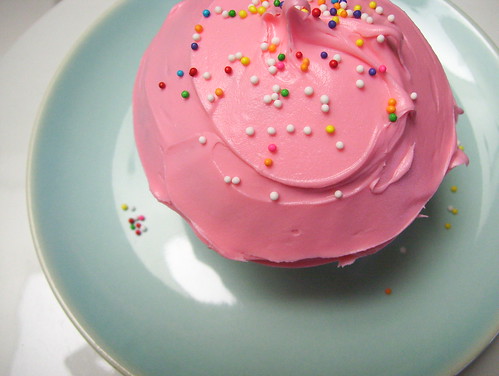
Photo by: simple up, courtesy of Flickr
I began writing anyway. Through a few pages I realized something. Besides knowing what the woman's problem would be--not being able to have a baby--I knew that she would be struggling with the five stones; I also knew I'd need a new visual if you will and if it couldn't be the stones it would have to be something else.

A pink cupcake was born.

Now, I'm not going to tell you the meaning of the cupcake. And I'm not going to take you through the plot I have so far (I want you to read the book after all) but I want to clue you in about how to create a great plot, at least the way I create a great plot.
  • Try not to rush it. Allow the story to speak through you. If you don't know the entire plot when first undertaking a book, begin anyway, the entire plot will come.
  • Keep a distance. Sometimes you need to experience a part of life before you can truly understand what a particular character is going through.
  • If the idea for a new book isn't coming at all, do some waiting. Ask questions of those you trust. They just may have an idea that will work for you.
  • Make sure you have a big enough problem to carry the main character through the book, and don't have the character solve their problem too easily. I use the 5 times rule. The main character tries at least 5 methods to overcome his/her problem. Not one of them works until try 5 or 6.
  • If your book is a series, make it unique enough to stand on its own. You don't want your reader saying, "This sounds just like the first book." You want the books to connect but you don't want them to mirror each other in the same way you would look at yourself wearing the same outfit. Writing a series is sort of like looking at yourself in the mirror wearing a pink outfit, but the mirror shows you wearing a red one. 
When it comes to creating a great plot, the plot will only be as great as you let it. If you try to push your views too hard, or push the plot in the way you like the best, you may find that a great amount of re-writing is needed.

Do it right the first time.


Wednesday, January 16, 2013

Writing Out Loud

I don't know about you, but writing for me is a creative endeavor. I'd like to think that I choose the best words for my work and give them even greater life by the way I use them.

Photo by Tony Evans, courtesy of Flickr
But sometimes, I'm quite frankly, stumped.

I'm working on a new book that has been giving me troubles: The title: The Feast. I scrambled for just the right words and direction for months and put the work aside again and again. And then one day I was at lunch with my sisters. I told them about my dilemma, that some words were coming but they didn't seem to be the right ones. I felt like I was forcing some and standing still with others.

The suggestion came. "Why don't you..."

Photo by Moyan Brenn, courtesy of Flickr
Now if I were to tell you what my sisters said, I would be giving away the plot, so just let me say this: I got started on my book just the other day and the story is flowing nicely.

Photo by: Horia Varlan, courtesy of Flickr
Talking about your plot struggles can open the doors to continued writing. There is something about sharing where you're at and allowing others who care about you to fill in the gaps. It's kind of like trying to see the forest through the trees. Sometimes you need some distance and another set of eyes to really get the picture of where your book should be going!

I'm glad I listened.

Monday, December 17, 2012

Keeping Your Focus in Writing

It isn't always easy to keep your focus in writing. If you don't even have a minimal outline, taking you from one scene to another, it is easy to get lost.

Photo by: pfly, courtesy of Flickr
Without a map of some sort, you may find yourself in the creek when you intended to scale the mountain. And while I often write by the seat of my pants I also keep my flight in check by remaining focused on what the main character wants.

I need to know what he/she wants at the beginning of the story, and if what he/she wants is somehow overshadowed by unrelated scenes or not so needed characters, I may find that my story is leading me off the page.

And that's something, as a writer, that you don't want. You want your readers to stay engaged. You want them to continually ask, "What's going to happen next?" not "Why is this in there?" or "I'm lost."

If you fly by the seat of your pants in your writing like I do, take a leap of faith and stop your writing for a moment. Reflect on where your character began and what he/she is up to until this point.

Does what happens on page 2 connect with page 8 and page 10 and page 20, for example?

I love the "so what" factor. Go through each of your scenes and ask the "so what" question.

"Does this scene contribute to the overall plot of my book?"

cm195902, courtesy of Flickr
If not, take it out.

You'll find yourself climbing that mountain again before you know it.

Saturday, June 9, 2012

5 Secrets to Beginning a New Novel

Since I am in the process of beginning a new novel, I wanted to let you in on a few secrets I have discovered through the years when it comes to writing a great book.

Here they are:

Know the Basics of Plot

1. Before you start, know who the main and secondary characters will be, the setting and a pretty good idea of the plot. Remember, I said a PRETTY GOOD idea. Something happens to me when I write; suddenly, the characters take over and the plot changes, and in fact, becomes better. Leave yourself open to change as you write.

Research
Photo by Paul B, courtesy of Flickr

2. Get a bit of research done. I am TERRIBLE at this one and so what happens is that I'm writing about a cruise ship that is about to dock in Hawaii. Here are a few things I needed to know right away because a murder had been committed on board. How does the Honolulu Police Department function? What do their uniforms look like? How large is a typical department? What about lawyers? How do they dress? How do they perform? What of cruise ship negligence? What's a famous recipe in Hawaii that has eggs in it? And the list goes on...Once this information is at your fingertips you can write without having to stop mid-sentence to figure something out.  

Action!


3. Keep in mind that your reader wants to be involved right away. I first began my story with some reflection on why Susan (my main character) was taking this cruise, but quickly discovered that the better beginning would involve the reader in some action-- and so a murder was created.

Move forward

4. Try not to correct as you go unless you realize early on that you've bungled the beginning like I did. Keep writing and try not to go back on what you've written until at least the next day, and then only go back a page or two to refresh your mind.


Photo by J. Chris Vaughan, courtesy of Flickr
Take a break

5. If the muse quits on you, take a break, and then go back to your work. Your writing will be better. I like to take 15 minute breaks or use the time to do a writing exercise unrelated to the book I am working on.

When it comes to the beginning of your book, you not only need to make it captivating but realistic. Keeping your facts straight will lend credibility with your readers and moving forward and taking the breaks when you need them will get that book finished before you know it.


Friday, May 18, 2012

Gearing up for Free Workshop!

Okay, folks, today is the last day to sign-up for my class! Sure, you can walk in tomorrow without signing up (I'll still take you), but it's always a good idea for a presenter to know how many people are attending.

Photo by: jm3, courtesy of Flickr

We will be discussing plot. That means characterization, setting, beginnings, endings, and that thing called, "the main problem" of your character and how to solve it by the end of the book.

Having a hard time getting started on your novel? Are you about mid-way through and feeling as if the story is going down hill? Do you think all of your characters sound the same, and you want to change that? What about your setting? Are you using what you know?

These questions and more will be answered at the Writing Your Book Workshop.  Here are the details:

Date: Tomorrow! (May 19)
Time: 1-2:30
Place: Bountiful/Davis Art Center, 745 South Main Street, Bountiful

Please pass the word along, and bring a friend. I have a FREE gift for everyone who attends.

Wednesday, April 18, 2012

FREE Class Coming in May!

Hello readers and writers!

If you missed my last Writing Your Book Workshop in Ephraim, you'll not want to miss another free event coming up in May. Here's a tidbit:

Overwhelmed about writing your first book? Each of us has a book within us, and I help you find it! This FREE hands-on workshop takes you through idea, plot, setting, and characterization and gets you started on your first winning paragraph. 

Date: Saturday, May 19
Time: 1-2:30 p.m.
Place: Bountiful/Davis Art Center
            745 South Main Street
            Bountiful, Utah

To Register call the Art Center at: 801-292-0367 or contact me at: kathy@ariverofstones.com. 


Get a personally signed copy
of this book for only $10


Thursday, April 5, 2012

Asking Questions to get (Character, Plot, Setting) Answers

I am a firm believer in asking questions. Not just in my spiritual life but in my book writing life, which often happens for me spiritually anyway. And the questions I usually ask in the book writing world have to do with character, plot and setting.

Photo by: Bilal Kamoon, courtesy of Flickr
The questions may be: What problems will this character face and how will she overcome them? When she doesn't get that job, what will she do? Where is her job located and how is the location just the right place (or the wrong place) for the job to be?

I like to ask questions, because in asking I get answers, and the answers aren't always what I expect.

Take my latest Christian novel, "Conquering Your Goliaths: A Parable of the Five Stones." When Ms. Virginia Bean loses her job I expect that she'll go in search of a new one, but what ways does she manage to look for one? Who will she meet along the way to help her? What will be a surprise in this search for a new job? What obstacles will be in her way? How will she overcome?

Photo by: jemsweb, courtesy of Flickr
I had an idea of how I thought the story might end, but I was open to the characters telling me what they thought. If you're a writer, the thought of characters speaking to you about their life will probably not come as a big shock to you, but if you've just started out in writing, the thought might freak you out a bit.

Don't get freaked, get ready to listen, ask questions and be prepared for your character to tell you where it's at. There is something about not getting hooked into a plot when a better plot comes around. And I'm always ready to ask questions and get feedback.


Friday, March 16, 2012

Simple Outlines Create Success

You've heard of those (far out) outlines and profiles; those that specify hair color, eye color, habits, and speak about the details within each chapter, etc. But what I want to talk to you about today is putting together a simple outline--one that will get you writing instead of researching.

While I think it's important to research a story, I know that it is also easy to get stuck in the planning stage forever. That's why I like to use a simpler outline method.

Photo by Ed Yourdon, courtesy of Flickr
It goes something like this:

Character

Start by thinking of your main character and the traits and physical characteristics that apply to them. Get a fairly good idea of who they are by keeping your thoughts to one paragraph.

Setting

Now, take this character through a setting. Where would this character typically live based on their traits and physical characteristics? Focus on the main setting; where the primary character usually frequents.

Plot 

What is your main character's problem? What issue are they trying to solve?

When it comes to plot, you'll not want to make it easy for the character to succeed. Based on who they are and where they live, and their specific problem, you'll want to take the main character through some trials. In a book of say, 200 pages or more, expect the main character to go through at least five episodes that they must overcome to face the next obstacle. If everything is smooth sailing through your book, you don't have a story, and you don't have a life. Think about your own life. Is it free of challenges?

How does your main character try to solve their problems? After listing the five challenges that must be overcome, list their accompanying solutions; solutions, by the way, that don't necessarily work, but lead the main character forward.

Ending

How is the problem finally solved? Is the answer realistic based on the trials that the character has already overcome? Endings are just as important as beginnings, probably even more so. Have you ever read a book and the ending seemed forced? Did you hate the ending because it didn't appear realistic? The right ending is important for your book, and based on the trials overcome, you should be able to place the main character in the right ending.

When it comes to outlining a book, we all have our ways of getting the information down. Some writers I know use magazine pictures for all the main characters of their book; others use a poster board for all of the chapters and scenes of the book. On the board they can move (with sticky notes) what is going to happen in each chapter. If they decide on something else later, they just move the sticky notes.

But I happen to favor this method. It's simple and to the point. Plus, you're not spending hours and hours organizing (maybe even getting burned out) before you write that first line.


Friday, February 3, 2012

Editing your Book

I like to think of editing like using a shaping tool.

Don't get me wrong, I have no idea what this shaping tool would be called, but I do know the difference between a straight piece of wood and an elegantly shaped table leg.

Photo by: crows_wood, courtesy of Flickr
A piece of wood is the beginning of your work before you've even put pen to paper or keystrokes to computer. It's one of those things that you need to have first before you can really get to work. The idea can be shaped into anything you want: a toy, a table leg, even a shelf with pegs, but it will never be any of those things until you take the piece of wood to the next step.

Cutting away, whether through saw or blade isn't always the most easy task. After that first draft is written, what should a good writer let go of, what should they cut from their work? I look at the following things:

  1. Solid plot, characters and setting. Characters are the most important because they speak to readers in a way that plot and setting can't. I make sure that the characters, plot and setting are consistent in tone and look throughout the book.
  2. I look for holes in the manuscript. Stuff like a character that gets lost in the manuscript;those that I haven't written about for too many pages. 
  3. I may get a reader or two at this point, so that they can give me an overall opinion of the book and what they feel still needs some work.
After the first draft, I always go through a second one. These are some things that I look for:

  1. Extraneous words like and, the and but.  Sentences and paragraphs need to contribute to the book. Nothing is extraneous. 
  2. Extra "flowery" words that don't contribute to the overall feel of my work. 
  3. Photo by: TheLivingRoominKenmore, courtesy of Flickr
  4. Words that should be replaced for a better word, and words that make no sense. I just had this happen with my most recent edit. I used a word that was completely wrong for the sentence and had to re-work the sentence so that it would make sense. 
By the time I'm at my third draft, I'll need some great readers. I choose great readers as well as writers to go  over my work because a writer usually picks out something that a reader misses and vice-versa. My readers always read my book without compensation. This has been a real blessing to me. 

In the end, editing my book means shaving off all the unnecessary clutter, all of the stuff that means little and may even detract from the intent and direction of my book. And I like that just fine.

I'm looking for an elegantly shaped table leg. 


Wednesday, January 11, 2012

A Solid Plot

We all know rocks are solid, and they make a pretty good dent on a window, or should I say, through a window.

Photo by Hugo_Fstop, courtesy of Flickr
Plot should be just that solid.

If our story lags mid way through the book or story, there is something wrong with our plot.

If our ending is less than to be desired; especially if our ending has a "white knight" who saves the day or the ending is forced or too predictable, we may have a problem with plot.

Plot is a little like life with all of its variables. Some variable are planned; others are surprises that yet take us to the happy ending. We may have been trying to pay off our debts and are suddenly able to do it, we may be saving for a new house or struggling with a divorce. The end of our dilemma doesn't need to be necessarily "happy" but it needs to be understandable and "real." It needs to be something that would really happen.

Of course, romance writers would tell me something different, (writing rules are made to be broken) and yet the ending still needs to reflect what the main character has been going through during the entire book. We can't have a problem solved suddenly of "forgiveness," for example, usually in one chapter, and definitely not completely at the end of the book if the character hasn't worked through the problem throughout the story. 

When you are working on your plot it may be a good idea for you to outline it, but don't get stuck on keeping the plot the way you've constructed it, especially if one of the characters tells you during the writing that this new plot in this particular arena, will work better. Listen to your characters, let them tell you what they will say and do in any given situation. 

Photo by Jude Doyland, courtesy of Flickr
A solid plot can break through your main character's problems, but a weak plot's resolution appears forced. You've probably been reading a book and suddenly rolled your eyes because you really didn't think that character would drink the glass of wine, or visit with that particular person in that way, or get a job in that field.

Mystery writers may be raising their eyebrows now. "But what about the stupid things that people do, like tasting that class of wine when they don't trust that person who poured it?" Sure, characters do stupid things, even out of character sometimes, but the brunt of the plot has solid characters, those that do what they do because of who they are.