Showing posts with label voice. Show all posts

Monday, April 29, 2013

Writing for Young Adults

If you're considering writing a YA book, you may also want to consider the following tips:

When writing your book, consider the audience. A book with 15 year olds is a good choice for someone a few years younger, and characters that are say, 16-18 are better for a 14-15 year old. The reason? When you're a teen, you want to be a bit older than you currently are. I don't know what it is about that, but until you're in your 20s, the idea of being older is the cat's meow.


Photo by: Sarah Alamimi, courtesy of Flickr

When was the last time you heard "the cat's meow"? This brings us to tip number two. How do teens speak these days? What phrases do they use? What do they say when they're frustrated, sad, excited? Now, I'm the first to admit that many teens swear, and I'm not promoting swearing here, but I like the thought of someone getting angry and using a lighter slang word to get their point across.

What happens to a teen reader that has to read a classic? Well, unless they are of the unusual variety, nothing much. Teens need action, and lots of it. They need dialogue and a smattering of setting, but not so much that they decide to skip the 'boring' parts. Teens need teens that do scary things; things they've only dreamt about, but they also need realistic stories that deal with trauma in a real and positive way.

Does your main character have cancer? How does she deal with it? Are her parents divorced? How does she feel about that?
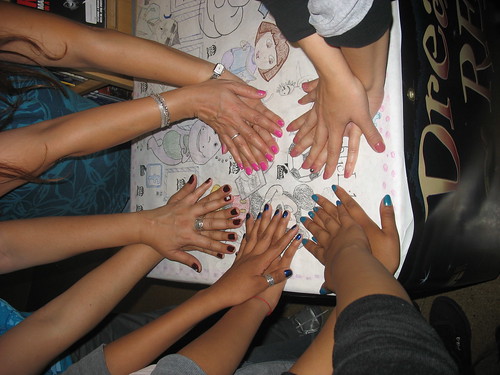
Photo by: San Jose' Library, courtesy of Flickr
Take your YA fiction novel deep, but not so deep that the reader is wondering where they are. Whether you're writing a mystery, a romance, or an adventure, consider their age, the way they speak, and what they dream about.

If you have a hard time relating to teens in your own life, you may have a hard time writing about them. If this is the case you need to spend some quality time, or at the very least, do some focused observation.

Unless your book is taking place in the 50s or 60s when you were a kid, you'll need a sufficient update.

Write teen books yourself? What advice do you have?


This book is primarily for the middle reader, can you see why?

Tuesday, May 15, 2012

Finding Your Writer's Voice

I hear a lot from writers about finding their writer's voice. They want to know how to find it, how you know when you've found it, and what sorts of things they should write about once their voice has been found.

I have an answer for all three of these questions, but keep in mind, they stem from my own personal journey and another writer may find them from climbing an entirely different mountain.

How to Find Your voice

I like to think of discovering your writer's voice sort of like finding a precious diamond and keeping it forever. Years ago, I lost the diamond out of my wedding ring. I managed to find it. A few months later, one of the prongs came lose again and the diamond was lost. Yes, I managed to find it again, but I told myself that I was going have my band adjusted to a lower setting before I wore my diamond ring again.


Photo by: jurvetson, courtesy of Flickr
I can't tell you the day I first found my writing voice, but it came about the time I lost my fears of making my writing perfect. It came when I cared more about my story and less about the grammar associated with it. It came when I let go of what I thought a writer "should be."

How You Know When You've Found Your Writer's Voice

Unlike losing your diamond, finding your voice is one of those things that sticks once its been found. You aren't always wondering if your piece of writing sounds authentic or "right" because what comes from your fingertips is the voice that you've discovered.

Your voice might be "a diamond in the rough," but your diamond is your diamond. You speak from your heart. You share your voice. You aren't trying to mimic another. The voice you share on paper is yours because you "feel" it.

What You Should Write About Once Your Voice is Found

I try to stay away from what's "popular" in the book market; instead, I focus on what comes to me in dreams, (waking and sleeping) what others suggest might be a good subject (that's how "Conquering Your Goliaths" came to be) and what subjects speak to me. I also consider the books I enjoy reading. Because I enjoy a good mystery as well as non-fiction and Christian fiction that speaks to the heart, much of my writing follows these three areas. All three of my published books follow the Christian fiction theme, and my first cozy mystery will be published next year.


Finding your voice comes easier if you're more focused on writing what you love and less focused on trying to make it sound "right." You'll never lose your writer's voice, so you might as well have fun with it and write what you enjoy.

Thursday, March 29, 2012

Writing for Money?

Much has been said on this topic, but I wanted to take a different turn on it.

I think it's important to write, I also think it's important to make money. But it's more important to me that I write without being absorbed in the end result--money.

Photo by: tnarik, courtesy of Flickr
If you're dreaming about becoming rich as a writer, quitting your current full-time job, raking in the dough after only a few short months of writing, think again. I don't want to burst any bubbles here, but the truth is, writers rarely get published that first year that they begin. And if they do, it's because they have their own blog or have published their own book. Writing for money rarely comes until the writer is seasoned, and even then, it comes slowly and intermittently, sort of like a dripping faucet.

Photo by: Jeff Golden, courtesy of Flickr
When I began to make some real money writing I wasn't focused on the money anyway. I was more focused on the project, the person I was mentoring, the opportunity to share what I had written. When the money came it was because of the timing of the project as well as the attention I'd given to the piece. When I worked with a writer, I focused on their strengths and opportunities for growth, and less on the money they'd be handing me.

The money came, of course. But it came only after I'd prepared myself to receive it. I had to focus in a different place; my concern had to be for others more than it was for myself.

If this sounds a little "far out" to you, try it anyway. Focus on ways to improve your writing. Take classes. Be open to ideas that come to you. Let go of fear when you write and find your voice. Be assured that your distinct voice will come, just as the money will come, in its time.


Monday, March 19, 2012

Sentence Structure

Since I began writing and publishing almost 30 years ago, I have learned a few things about sentence structure; what to do and what not to do, and what may just be your particular form of writing--something you don't mess with.

When it comes to writing, each of us (hopefully) has our own voice. What we say and how we say it is unique to us. We write, and someone else doesn't think we are trying to mimic C.S. Lewis, for example, though it feels like a great compliment to be like him.

We have our own voice. Our own style. The words we write come from our heart and we're less concerned about writing great and more concerned with writing authentically.

Part of writing authentically means we get everything on paper (or computer) and then return to edit and improve. This is where sentence structure comes in. Some questions I ask myself at this stage are:

  • Is the sentence clear? When I read it out loud, does it make sense to me?
  • Do I have short sentences interspersed with long sentences? The long and the short of it is that short sentences are better for a blog. Long sentences work better for a novel. Yet, you don't want to over-run the reader with lengthy sentences without breaking them up with short ones. (Take a look at paragraph 3 of this blog. See how I've woven short and long sentences into one paragraph).
  • Do you favor long paragraphs? For most readers, they get lost in long paragraphs. If you have a particularly long paragraph, shorten it into two. You don't want to lose your reader by not providing them with enough white space. (White space is the space on the page empty of words). White space gives a rest to the reader's eyes, and makes the page more pleasant to read.
Hawaii, 2007
  • What is happening with my grammar; with my word choice? While it's important to keep our authentic voice in everything we write, it's also important that our word choice is the best we have--even if we have to  flip through a thesaurus. 
Though sentence structure, ultimately, is the building blocks of or voice, it's important to send our words out as clear and undiluted as possible. Like a vast ocean, we want to see into its depths. 


Friday, January 27, 2012

Getting "Real" with your Story--the Importance of Voice

When I first began writing I figured I'd have to sound like a great writer to be one. What I didn't realize is that I just needed to sound like myself.

But what was that?

Photo by: Daehyun Park, courtesy of Flickr
At first I didn't know what my voice was. I didn't know what it sounded like. Sure, I used it every day to talk with people, but I didn't have a clue how to use my voice in writing. I didn't know where to start. 


Voice is an interesting thing. It's something that comes from inside you and it's something that someone else cannot teach. Yes, they can give you writing exercises to bring it out, you can read all about "voice" in books and you can take writer's classes with some pretty heavy discussion about what "voice" is, but until you experience it yourself, your writing will never take on the glow you have imagined for it.

Voice is especially important when you consider your characters. But it is equally important as you describe setting. What does your reader hear when they read your words? Are they re-reading them or are they taking them in? And if they're re-reading, is it because your words are full of depth and meaning, or because the reader is confused?

Photo by Nick Piggett, courtesy of Flickr
Sharing your heart is a bit like putting it out there for folks to take a look at. Like a t-shirt that says, "Got Milk"? your voice will either draw the reader in to take a drink or leave them languishing in the wilderness for a drop.

Voice comes with time spent at the key board. It might not visit you in that first short story, or even your first novel, but one day you'll feel it when it comes to you. Suddenly, it's as if the words are falling to you from the sky; your skin prickles and you know what to type without even thinking about it.

That's when you know that your voice has found you